

That sore-but-satisfied feeling after a tough workout? It’s a classic sign of progress. But what if you could bounce back even faster and feel stronger for your next session?
The secret is hiding in plain sight: amino acids. These are the fundamental building blocks of protein, and giving your body the right ones at the right time is the key to rebuilding damaged muscle, easing soreness, and getting you back in the game.
Your Blueprint for Faster Muscle Recovery
Every time you lift, run, or push your limits, you’re actually creating thousands of microscopic tears in your muscle fibers. Don’t panic—this is a good thing! It’s the signal that tells your body it’s time to rebuild bigger and stronger.
Think of it like a construction crew showing up to a job site after a day of demolition. This expert crew needs specific materials to start rebuilding, and in your body, those materials are amino acids.
This whole rebuilding process is called Muscle Protein Synthesis (MPS). For your muscles to actually grow and recover, the rate you build them up (synthesis) has to be greater than the rate you break them down. If you don't have enough amino acids on hand, your body simply can't keep up with the repair demands.
The Role of an Expert Repair Crew
Imagine amino acids as a highly specialized repair crew, where each member has a specific job:
- The Framers: Amino acids like Leucine, Isoleucine, and Valine (the famous BCAAs) are the first ones on the scene. They act like foremen, kicking off the entire rebuilding process.
- The Masons: Others like Glycine and Proline are essential for reinforcing all the connective tissues—they’re the mortar that holds everything together and keeps you resilient.
- The Support Staff: To finish the job right, all nine Essential Amino Acids (EAAs) have to be present. You can't build a house with just lumber and nails; you need the whole team.
The core principle of recovery is simple yet incredibly powerful: Providing your body with these essential materials is the most direct way to supercharge repair and maximize your fitness gains. When you supply a steady stream of the right amino acids, you ensure the construction project never runs out of supplies.
By understanding how these tiny but mighty molecules work, you can turn your post-workout window into a powerful phase of growth and adaptation. This guide will give you a clear map for using amino acids to optimize your muscle recovery, cut down on downtime, and hit your fitness goals more efficiently.
How Amino Acids Fuel Muscle Repair
Every tough workout leaves its mark, creating thousands of microscopic tears in your muscle fibers. This might sound bad, but it’s actually a powerful signal. It tells your body it's time to rebuild, adapt, and come back stronger. This is where amino acids for muscle recovery step onto the scene.
Think of your muscles like a brick wall. The workout strategically knocks out a few bricks, creating the stimulus for improvement. In response, your body sends out a repair crew, and amino acids are the new, stronger bricks they use to not just patch the wall but to fortify it for the future. This whole rebuilding operation is what we call Muscle Protein Synthesis (MPS).
But there’s a constant tug-of-war happening inside your body. While MPS is busy building new muscle tissue, another process called Muscle Protein Breakdown (MPB) is working just as hard, breaking down old or damaged tissue.
The Critical Balance for Growth
For your muscles to actually recover, repair, and grow, the math is pretty simple: the rate of MPS must be greater than the rate of MPB. If breakdown starts winning, you won’t recover effectively and could even lose muscle mass. Your goal is to constantly tip the scales in favor of synthesis.
This is exactly why having a ready supply of amino acids is so critical. By giving your body these fundamental building blocks right when it needs them, you equip the repair crew with all the materials to work faster and more efficiently than the demolition crew. This ensures you’re in a net positive state of protein balance, turning your recovery time into a powerful growth phase.
At its heart, muscle recovery is a biological balancing act. Supplying your body with the right amino acids ensures that muscle synthesis consistently wins out over breakdown, leading to stronger, more resilient muscles.
This infographic lays out the core functions of amino acids in the recovery process, from rebuilding tissue to managing inflammation.
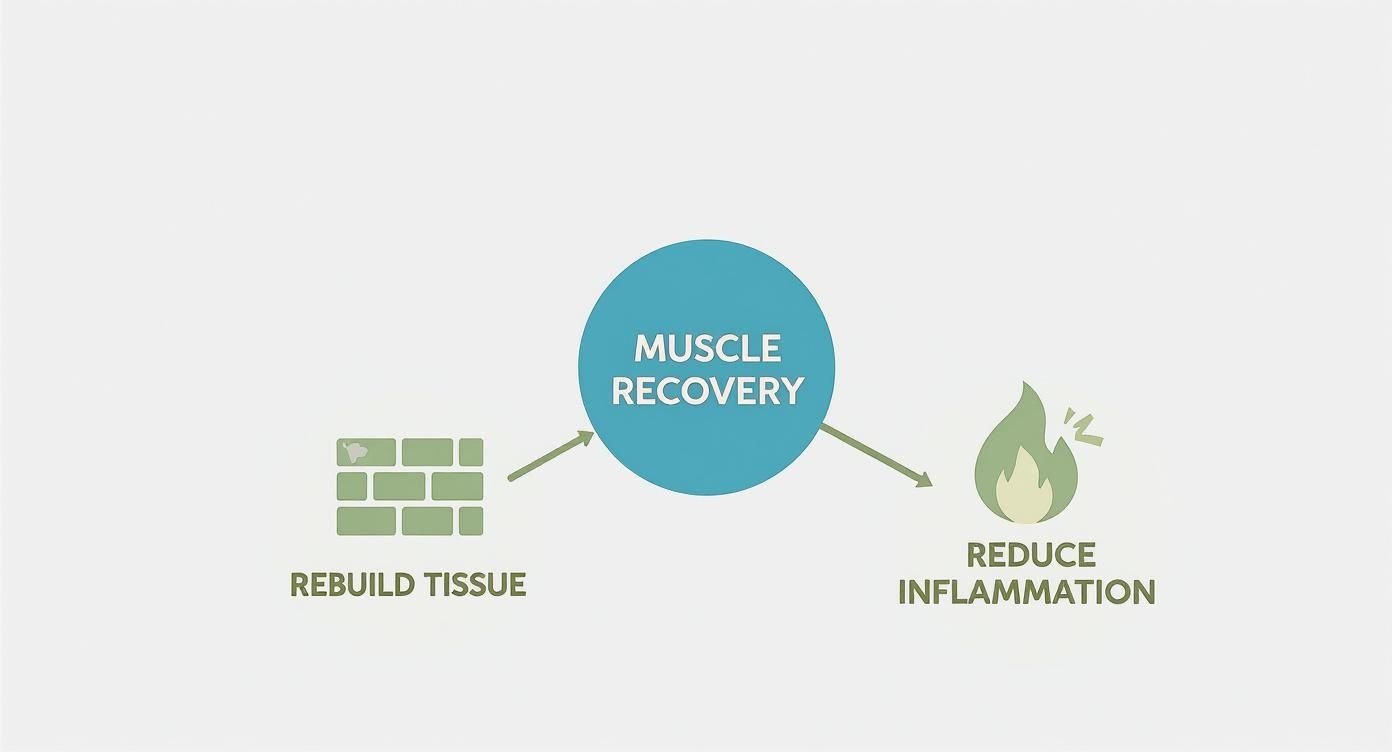
As you can see, recovery isn't just about patching up muscle fibers. It's a much bigger picture that also involves protecting your body's support structures.
Beyond Muscle Fibers to Connective Tissue
Real, durable recovery goes beyond the muscles themselves. It has to include the vital connective tissues—your tendons and ligaments—that support your every move. Key amino acids like glycine, L-proline, and L-lysine are the primary components needed for collagen synthesis, the process of rebuilding this crucial framework.
Taking care of this system is just as important as fueling MPS. We dive deeper into this in our complete guide to supplements for collagen production. By making sure these specific amino acids are available, you not only speed up muscle repair but also strengthen your entire musculoskeletal system, reducing injury risk and improving your durability for the long haul.
EAAs: The All-Star Team for Recovery
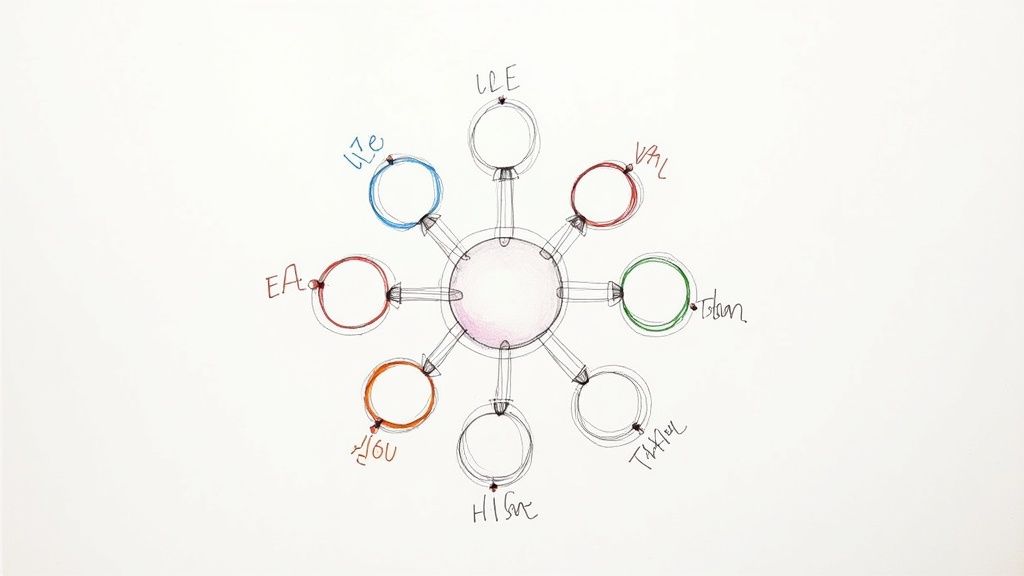
While certain amino acids tend to get all the attention, real muscle recovery depends on the entire team working together. Think of the nine Essential Amino Acids (EAAs) as the starting lineup for a championship basketball team. Sure, you have superstars like Leucine, but the team can’t win if the other eight players aren't on the court, ready to contribute.
These nine EAAs are called "essential" for a reason: your body can't make them. You have to get them from your diet or supplements. When you supply them all at once, they work in concert to kick Muscle Protein Synthesis (MPS) into high gear. Having just a few aminos is like having a couple of star players on the court; having all nine is like fielding the whole unstoppable roster.
This synergy creates the perfect biological environment for rebuilding and strengthening muscle tissue. If even one EAA is missing, the entire repair process can grind to a halt, leaving a critical link missing in your recovery chain.
The Power of a Complete Profile
Time and again, scientific research has shown that a full spectrum of EAAs is far more effective at sparking muscle repair than just a few isolated aminos, like BCAAs on their own. The presence of all nine sends a clear signal to your body that every single building block is available, allowing MPS to run smoothly and without interruption.
This isn't just theory—it has some pretty profound real-world applications. A complete EAA profile is so powerful that it can help preserve muscle even when you're not exercising. This makes EAAs an incredibly valuable tool not only for athletes but for anyone facing a period of inactivity.
When your body has access to all nine essential amino acids, it has the complete instruction manual and all the required materials for muscle repair. This comprehensive approach ensures the recovery process is never held back by a missing piece, leading to more consistent and effective results.
A landmark 28-day bed rest study brought this effect to life. Researchers found that participants who consumed an EAA-based formula daily held onto significantly more muscle mass than those who received a placebo. This highlights the powerful, predictable relationship between EAA intake and muscle preservation—a crucial insight for anyone recovering from an injury or dealing with forced rest. You can read the full research on how EAAs preserve muscle during inactivity to learn more.
Ensuring No Weak Links
Ultimately, using amino acids for muscle recovery is all about providing a complete solution. By supplying your body with the full team of EAAs, you’re making sure there are no weak links to hold back your progress. Each one plays a unique and essential role in the complex biochemistry of repair.
So, while it’s easy to focus on individual star players, the smartest strategy is to support the entire team. This ensures every aspect of muscle protein synthesis is fully supported, helping you bounce back faster, feel stronger, and stay resilient.
Understanding BCAAs and Their Unique Role
When we talk about Essential Amino Acids, a specific trio—the Branched-Chain Amino Acids (BCAAs)—almost always steals the show. This group, made up of Leucine, Isoleucine, and Valine, has built a solid reputation for its direct and powerful impact on muscle recovery.
Think of muscle repair like building a house. If the nine EAAs are all the materials you need to get the job done, the BCAAs are the specialized crew that shows up first and gets the whole project started. What makes them so special is their unique molecular structure, which lets them bypass the liver and get metabolized directly in your muscle tissue. It's like an express lane straight to where the work needs to be done.
The BCAA Power Trio
Each member of this group has a distinct job, but they work together perfectly to support your recovery. Understanding what each one does makes it clear why they're such a powerhouse team.
-
Leucine: The Master Switch: Leucine is the undisputed star player here. It acts as the key signal that flips the switch on Muscle Protein Synthesis (MPS) by activating a pathway called mTOR. In simple terms, Leucine is the foreman on the job site who yells, "Alright, let's start building!"
-
Isoleucine and Valine: The Supporting Crew: These two are the essential backup. Isoleucine helps pull glucose into your muscle cells for energy, while Valine helps fight off both physical and mental fatigue during your workout. They make sure the construction site has enough power and stamina to keep things moving.
This is exactly why BCAA supplements, especially those high in Leucine, are known to significantly cut down on that post-workout muscle ache—what we call Delayed Onset Muscle Soreness (DOMS)—and speed up the entire repair process.
By directly signaling for muscle repair and providing on-site energy, BCAAs act as a rapid-response team. They don't just supply building materials; they actively manage and energize the recovery process from within the muscle itself.
This isn't just theory; we can see the results in real-world studies. Research has shown that giving trained athletes a leucine-enriched EAA supplement led to a 25% increase in their muscle protein synthesis rates. For people doing resistance training, specific BCAA protocols boosted muscle protein synthesis by 18%. You can dive deeper into these findings on protein synthesis and muscle growth if you're curious.
Now, while BCAAs are fantastic at getting the party started, it’s crucial to remember they’re just part of the larger EAA team. For the muscle-building project to actually be completed, all nine essential amino acids have to be on site. The BCAAs flip the switch, but it's the full team of EAAs that provides all the materials needed to finish the job right.
Supporting Connective Tissue with Collagen Aminos
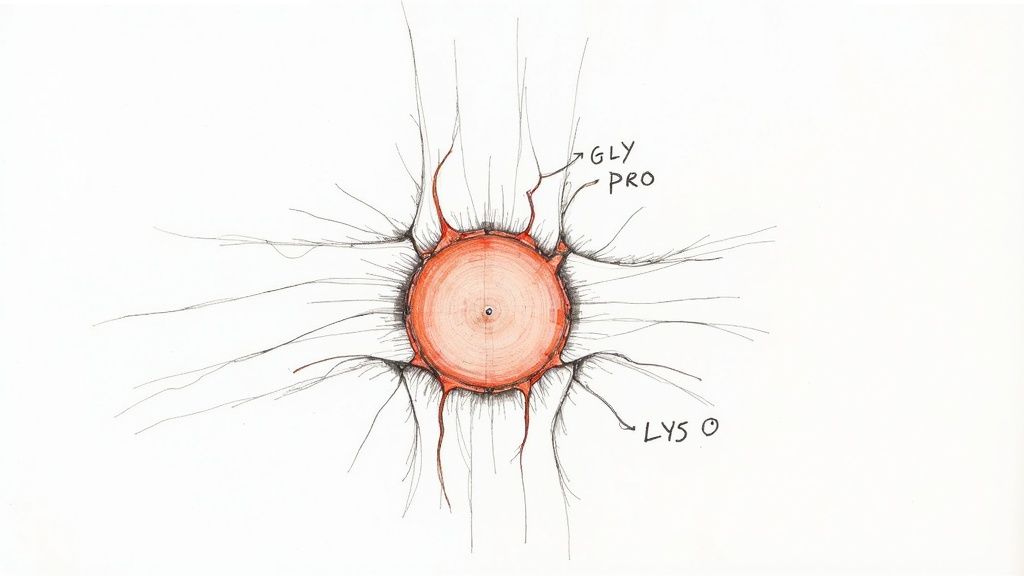
Real recovery goes way beyond just patching up muscle fibers. Every time you train hard, you're putting a ton of stress on your entire support system—the tendons, ligaments, and joints that bear the load of every squat, press, and sprint. Focusing only on muscle protein synthesis is like renovating a house but ignoring a crumbling foundation. To build back stronger, you need an approach that supports these critical connective tissues, too.
That’s where collagen synthesis enters the picture. Collagen is the most plentiful protein in your body, acting as the "glue" that gives structure and strength to your skin, bones, and—most importantly for athletes—your connective tissues. To build and repair this intricate network, your body needs a specific set of amino acid building blocks.
The Key Building Blocks for Collagen
While BCAAs get the spotlight for triggering muscle growth, a different crew of amino acids takes the lead when it comes to rebuilding your body’s structural framework. These are the non-negotiables for creating durable, resilient joints and tendons that can handle the demands you place on them.
- Glycine: This is the absolute star of the show. Glycine makes up about a third of collagen's entire structure, so getting enough is essential for effective repair.
- Proline: Working hand-in-hand with glycine, proline helps form the unique triple-helix shape that gives collagen its incredible strength and stability.
- Lysine: This essential amino acid is vital not just for producing collagen but also for cross-linking the fibers together, which is what makes them so tough and durable.
Think of collagen as a heavy-duty rope woven from three smaller strands. Glycine, proline, and lysine are the individual fibers that make up those strands. If you don't have a steady supply of all three, that rope starts to get weak, frayed, and is far more likely to snap under pressure.
Giving your body the raw materials it needs to produce its own collagen is a cornerstone of long-term athletic health. By supplying these specific amino acids for muscle recovery and connective tissue support, you aren’t just healing from today's workout—you're fortifying your body against future injuries. Formulations designed with these key building blocks simply help your body do its job more efficiently.
This process ensures your entire musculoskeletal system stays healthy and resilient. To really get a handle on this foundational protein, you can learn more about what exactly collagen is and why it's so important in our detailed guide. It's a huge piece of the total recovery puzzle.
How to Use Amino Acids for Peak Recovery
Knowing which amino acids to take is a huge step, but understanding when and how much to use them is what truly unlocks their potential.
Think of it like this: having the best building materials for a construction project is useless if the delivery truck shows up after the crew has gone home. Timing and dosage are everything when you're using amino acids for muscle recovery.
This is your practical guide to building an effective strategy. The goal is simple: keep a steady supply of these crucial building blocks available right when your muscles are most receptive to repair.
Optimal Timing for Maximum Impact
Your body’s need for amino acids isn’t constant—it skyrockets around your workouts. By timing your intake strategically, you can meet this demand head-on and give your body exactly what it needs, when it needs it.
There are three key windows to consider:
-
Pre-Workout: Taking amino acids before you train helps "prime the pump." It saturates your muscles with the resources needed for endurance and can help minimize muscle protein breakdown during your session.
-
Intra-Workout: For those longer or more intense sessions, sipping on an amino acid drink can be a game-changer. This provides a direct fuel source to working muscles, helping to delay that feeling of fatigue.
-
Post-Workout: This is the classic "anabolic window" you've probably heard about. Consuming fast-absorbing amino acids within an hour after exercise kick-starts muscle protein synthesis (MPS) when your body is most eager to repair and rebuild.
But here’s the most critical takeaway: consistency trumps all. Whether you take them before, during, or after, the real key is ensuring your muscles have the amino acids they need when the demand for repair is highest.
Dosing and Food Sources
Getting the right amount is just as important as getting the timing right. While everyone's needs vary based on their body weight and how hard they train, some general guidelines are a great place to start.
Here's a handy table to break down the specifics for active individuals looking to optimize their recovery.
Amino Acid Timing and Dosing Guide
| Amino Acid Type | Optimal Timing | Suggested Dose | Key Benefit |
|---|---|---|---|
| Essential Amino Acids (EAAs) | Pre-, Intra-, or Post-Workout | 10-15 grams | Comprehensive muscle repair and growth |
| Branched-Chain Amino Acids (BCAAs) | Pre- or Intra-Workout | 5-10 grams (high in leucine) | Reduces muscle breakdown and fatigue |
| Glycine, L-Lysine, & L-Proline | Post-Workout or Before Bed | 5-10 grams (combined) | Supports collagen and connective tissue |
This table gives you a solid framework, but remember to listen to your body and adjust as needed.
Of course, supplements should always complement a solid nutritional foundation, not replace it. You can find excellent sources of these amino acids in whole foods that you’re likely already eating.
- Animal-Based: Lean meats, poultry, fish, eggs, and Greek yogurt are packed with complete proteins, giving you all the EAAs in one shot.
- Plant-Based: Quinoa, tofu, edamame, and lentils are fantastic plant-based options that provide a robust amino acid profile.
By combining smart supplementation with a protein-rich diet, you create a powerful, multi-faceted approach to recovery. To explore more ways to enhance your routine, check out our guide on the best supplements for muscle recovery. This ensures your body always has the tools it needs to bounce back stronger.
Common Questions About Amino Acids
Diving into the world of supplements can feel a bit overwhelming, and it's natural to have questions. When it comes to using amino acids to help your body bounce back after a tough workout, getting clear, straightforward answers is key to making the right choice for your goals.
Let's break down a few of the most common things people ask.
Should I Take EAAs or BCAAs for Muscle Recovery?
This is probably the biggest question out there. While BCAAs (especially leucine) are great for kick-starting the muscle repair process, they can't finish the job on their own. For most people, a complete Essential Amino Acid (EAA) supplement is the smarter move because you need all nine EAAs to run the full cycle of Muscle Protein Synthesis.
Here’s an easy way to think about it:
BCAAs are like the ignition key that starts your car's engine. But EAAs are the key plus a full tank of gas. You need both to actually get anywhere.
If your diet is already packed with high-quality, complete protein, BCAAs might give you a slight edge. But for everyone else, EAAs offer more comprehensive recovery insurance.
Can I Get Enough Amino Acids from Food Alone?
Absolutely. A well-planned diet filled with high-quality protein sources—think meat, dairy, eggs, and soy—can definitely provide all the amino acids your body needs.
The real advantage of free-form amino acid supplements comes down to one thing: speed. They don't need to be digested like whole food protein, so your body absorbs them incredibly fast. This makes them perfect for that crucial post-workout window when your muscles are practically screaming for nutrients.
Are Amino Acid Supplements Safe?
Generally, yes. For healthy people, amino acid supplements are considered very safe when you stick to the recommended doses. If you go overboard, you might experience some minor digestive issues like bloating or an upset stomach, but that's about it.
It's always a good idea for anyone with pre-existing kidney conditions to chat with their doctor before starting any new supplement. Your kidneys are involved in processing amino acids, so it's best to be safe.
For a recovery plan that supports not just your muscles but your entire connective tissue framework, a plant-based approach can make all the difference. Staye is specifically formulated with key amino acids like glycine, L-lysine, and L-proline to help your body build its own collagen, promoting joint and tissue resilience from the inside out. Discover the benefits of Staye here.