

The most effective path to more collagen isn't necessarily swallowing more of it. Instead, it's about giving your body the exact tools it needs to build its own.
Think of nutrients like vitamin C, zinc, amino acids, and certain plant extracts as the essential crew for your internal "collagen factory." This guide is all about getting that factory running at peak performance.
Why Building Collagen Beats Taking It
Ever wondered what’s really going on when you take a collagen supplement? The market is absolutely massive—projected to hit USD 9.4 billion by 2032, which just goes to show how many of us are focused on our skin and joint health. You can see more on this explosive growth at persistencemarketresearch.com.
But while scooping pre-made collagen into your smoothie is popular, it’s not the only way—and maybe not even the most efficient way—to support your body.
A smarter strategy is to provide your body with the fundamental building blocks it needs to do the job itself. This approach is all about synthesis—your body's natural, internal process of creating brand-new collagen fibers.
Here’s an analogy: you can either buy a pre-built, one-size-fits-all house (that’s like taking collagen), or you can supply a master construction crew with top-tier bricks, mortar, and a detailed blueprint. The second option allows your body to build stronger, more resilient structures exactly where they're needed most.
The Power of Raw Materials
This guide pulls back the curtain on that internal construction process. We'll get into how specific nutrients act as both the raw materials and the expert foremen for collagen production.
- Essential Nutrients: You'll learn the specific jobs of vitamins and minerals like Vitamin C and zinc, which are non-negotiable for activating the enzymes that assemble collagen.
- Amino Acid Foundation: We’ll break down the core amino acids—glycine, proline, and lysine—that form the literal protein structure of collagen itself.
- Plant-Based Support: Discover how certain plant-based boosters can shield your existing collagen from damage while revving up your body's manufacturing power.
By understanding how to fuel your body’s own production line, you can take a more intelligent and sustainable approach to achieving vibrant skin, resilient joints, and all-around wellness. To take it a step further, you can also explore our guide on foods that support collagen production to round out your strategy.
How Your Body Builds Collagen From Scratch
Here’s a common misconception: when you take a collagen supplement, your body doesn't just absorb it whole and shuttle it directly to your skin or joints. It's a bit more complex than that. Your body actually runs a sophisticated internal factory, constantly building this vital protein from the ground up.
Understanding how this factory works is the key to seeing why certain supplements for collagen production are so effective.
Think of it like building a house. The entire construction project happens inside specialized cells, mainly fibroblasts. You can imagine these cells as the bustling factory floor where all the magic happens.
The first major step inside this factory is creating "pre-fabricated walls" called procollagen. This is the direct precursor to the strong, flexible collagen that gives your body its structure.
The Raw Materials for Assembly
To build these procollagen walls, your body needs a specific set of raw materials. These are the fundamental amino acids that come together to form the unique triple-helix shape of collagen. The most important ones are:
- Glycine: This is the MVP, making up roughly one-third of collagen's entire structure.
- Proline: Another key player that helps create the protein's signature twisted shape.
- Hydroxyproline: A special version of proline that's crucial for giving the final collagen molecule its stability.
These amino acids are the literal bricks and mortar for your collagen house. If you don't have a steady supply, the entire construction process grinds to a halt. This is exactly why a protein-rich diet is the true foundation for healthy collagen levels.
The Construction Crew and Their Foreman
But just having a pile of bricks and mortar isn't enough to build anything, right? You need a skilled construction crew to put it all together. In your body, this crew is made up of specialized enzymes that link the amino acids in a very precise sequence.
And this crew can't work without clear direction from a master foreman. When it comes to making collagen, that foreman is vitamin C.
Vitamin C is absolutely non-negotiable for collagen production. It acts as a critical co-factor, essentially flipping the "on" switch for the enzymes that assemble procollagen. Without enough vitamin C, the entire production line shuts down—no matter how many amino acids you have ready to go.
This infographic simplifies how the raw materials become the finished product.
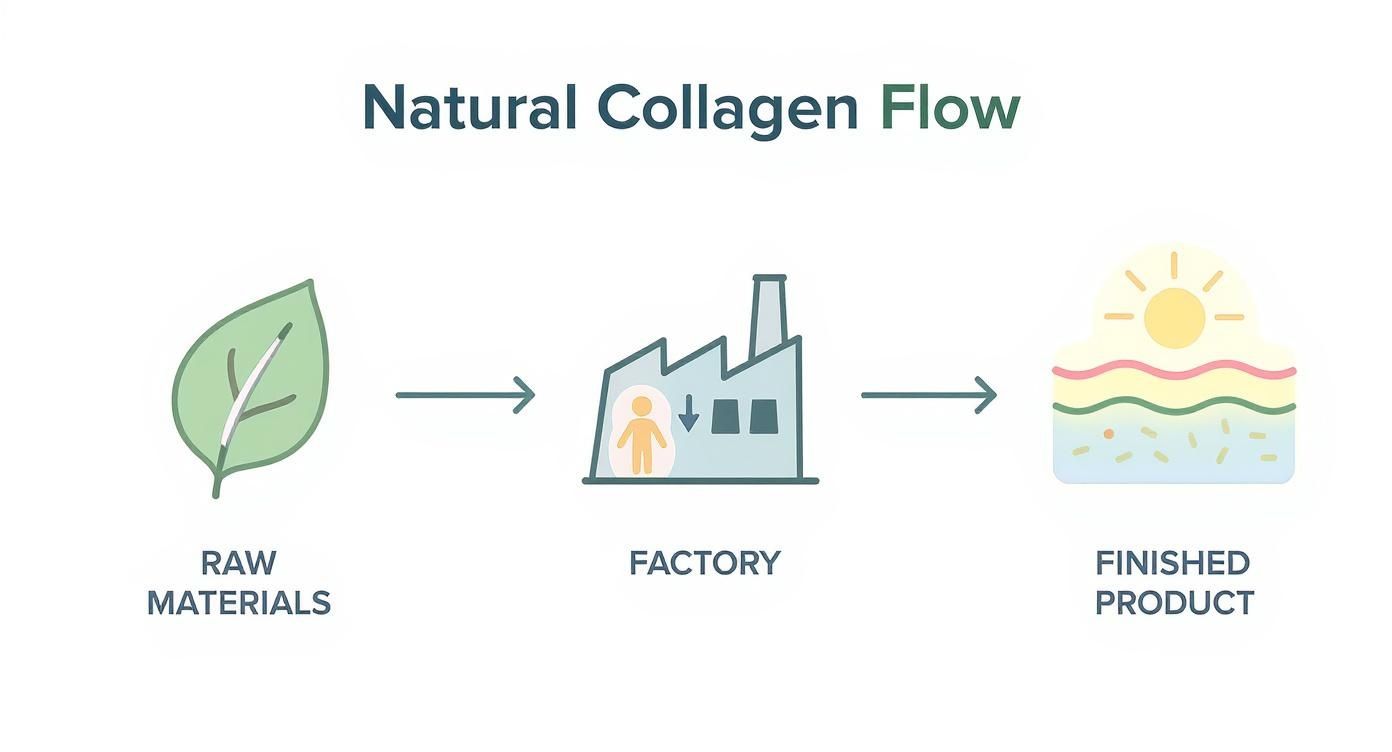
As you can see, giving your body the right nutrients allows it to efficiently manufacture the collagen it needs for glowing skin and healthy tissues. To dive deeper into this essential nutrient, you can check out our guide on finding the best vitamin C for collagen production and see exactly how it fuels the process.
Once the procollagen is built, it gets moved outside the cell for one final transformation. Other enzymes snip off its ends, which allows it to assemble into strong, resilient collagen fibrils—the finished structure that gives your tissues their strength and elasticity.
The Essential Toolkit for Boosting Collagen

If your body’s collagen production is a high-tech assembly line, then certain nutrients are the essential tools and workers that keep it running smoothly. Without them, the entire operation grinds to a halt. Understanding what each nutrient does is the key to getting real results from supplements for collagen production.
Think of it this way: just having the amino acids—the "bricks"—isn't enough. You need a specialized crew to assemble them correctly, secure the structure, and add the finishing touches. This is where a targeted toolkit of vitamins and minerals becomes so important.
Vitamin C: The Spark Plug of Synthesis
Vitamin C is probably the most critical player in the entire collagen-building process. It acts like the "spark plug" that ignites the enzymes responsible for linking amino acids together into stable procollagen molecules.
Without enough vitamin C, this crucial step simply can't happen efficiently. Your body can have all the amino acids it needs, but the production line will be stalled. This is exactly why a severe vitamin C deficiency leads to things like poor wound healing and weakened connective tissues.
- Its Role: Activates key enzymes that stabilize the collagen helix structure.
- Top Food Sources: Citrus fruits, bell peppers, strawberries, and broccoli.
- Daily Goal: The Recommended Dietary Allowance (RDA) is 75 mg for women and 90 mg for men.
The Foundational Amino Acids: Bricks and Mortar
Amino acids are the literal building blocks of every protein in your body, and collagen has its own unique recipe. Three, in particular, form the core of the collagen protein helix, acting as the fundamental bricks and mortar.
- Glycine: This is the most abundant amino acid in collagen, making up roughly one-third of its structure. It's essential for forming that tight, triple-helix shape.
- Proline: Another key component that gives the collagen helix its rigidity, helping it maintain its strong, twisted structure.
- Lysine: This amino acid is vital not just for the initial structure but also for the cross-linking process that gives collagen its final strength and resilience.
While your body can produce some of these on its own, getting enough through your diet or supplements ensures your internal factory never runs out of raw materials. Foods like meat, bone broth, eggs, dairy, and legumes are all fantastic sources.
Zinc and Copper: The Structural Engineers
Once the basic collagen chain is formed, it needs to be properly organized and reinforced. This is where key minerals like zinc and copper come in, acting as the structural engineers of the project.
Zinc functions like the foreman on the job site. It’s a co-factor for an enzyme called collagenase, which helps remodel and manage collagen tissues. In simple terms, zinc helps clear out old, damaged collagen to make way for new, healthy fibers, ensuring the structural integrity of your tissues.
Copper, on the other hand, provides the finishing touch. It's essential for an enzyme that creates strong cross-links between collagen fibers. These cross-links are what give your skin its elasticity and your connective tissues their tensile strength. Without enough copper, your collagen framework would be weak and fragile.
Think of these minerals as the quality control team. Zinc ensures the blueprint is followed correctly, while copper welds the final structure together, making it strong enough to withstand daily stress.
Here’s a closer look at the key nutrients your body needs to build collagen effectively.
Key Nutrients for Natural Collagen Production
| Nutrient | Role in Collagen Production | Recommended Daily Intake | Top Food Sources |
|---|---|---|---|
| Vitamin C | Activates enzymes that stabilize the collagen helix. | 75-90 mg | Citrus fruits, bell peppers, strawberries, broccoli, kiwi |
| Glycine | Forms the core of the collagen triple-helix structure. | No RDA; varies by need | Bone broth, gelatin, meat, poultry, fish, legumes |
| Proline | Provides rigidity and stability to the collagen helix. | No RDA; varies by need | Bone broth, gelatin, eggs, dairy, cabbage, asparagus |
| Zinc | Co-factor for enzymes that synthesize and remodel collagen. | 8-11 mg | Oysters, red meat, shellfish, legumes, seeds, nuts |
| Copper | Essential for the enzyme that creates strong collagen cross-links. | 900 mcg | Organ meats, shellfish, nuts, seeds, dark chocolate |
By ensuring you have a steady supply of these essential tools—vitamin C, key amino acids, zinc, and copper—you give your body everything it needs to run its collagen factory at full capacity, building strong, resilient tissues from the inside out.
Exploring Plant-Based Collagen Boosters
Beyond the essential vitamins and minerals, there's a fascinating world of plant-based compounds that can supercharge your body’s ability to build and protect its own collagen. These aren't "vegan collagen" products—that’s a myth. Instead, think of them as powerful botanical allies that give your internal collagen factory the specialized support it needs to thrive.
Some of these compounds help reinforce your collagen's structure, while others act as its personal security team, defending it from damage.
This approach has caught on in a big way, and the market shows it. Powders have become the go-to format for collagen supplements, grabbing the biggest slice of the revenue pie. But capsules and gummies are quickly catching up, with a projected 8.81% compound annual growth rate. You can dive into the full analysis of collagen supplement market trends on mordorintelligence.com.

Bamboo Silica: The Structural Reinforcer
One of the standout ingredients you’ll see in plant-based supplements for collagen production is silica, often sourced from bamboo extract.
Imagine building a concrete wall. You'd use steel rebar to give it strength and prevent it from crumbling. That's exactly what silica does for your collagen. It’s a key mineral that helps reinforce the entire collagen matrix, giving it greater resilience and stability.
By making sure your body has enough silica, you’re providing one of the critical raw materials needed to maintain the structural integrity of your skin, hair, and nails.
Grape Seed Extract: The Collagen Protector
While some nutrients are busy building new collagen, others play the crucial role of protecting what you've already got. This is where grape seed extract shines. It’s absolutely packed with powerful antioxidants called proanthocyanidins, which are exceptional at neutralizing free radicals.
Free radicals are nasty, unstable molecules generated by things like UV radiation, pollution, and even stress. They cause oxidative damage that can directly break down your existing collagen fibers, speeding up the signs of aging.
By scavenging these damaging molecules, grape seed extract shields your collagen from breaking down. This protective action is just as important as the building process itself, helping you hold onto a youthful, resilient protein framework for much longer.
Of course, finding a quality formula is key to seeing real benefits. To get a better handle on what to look for, explore our in-depth guide on the best plant-based collagen supplements.
When you combine these botanical boosters with foundational nutrients like Vitamin C and the right amino acids, you create a truly well-rounded strategy for supporting your body's collagen from the inside out.
How to Tailor Your Collagen Strategy
Knowing which supplements support collagen production is one thing, but a one-size-fits-all approach almost never works. Your lifestyle, diet, and personal goals all play a huge role in what your body actually needs to thrive. The key is to tailor your strategy to give your body the exact raw materials it’s asking for.
This idea of personalization is what’s fueling the "beauty-from-within" movement. It’s no surprise the U.S. collagen supplement market was valued at USD 1.02 billion and is expected to climb to USD 1.77 billion by 2032. People are catching on to a more holistic, individualized approach to wellness. You can read more about this market growth and see just how big this trend has become.
A generic plan might leave you wondering if anything is happening, but a focused one can deliver results you can actually see and feel.
For Vegans and Vegetarians
If you’re on a plant-based diet, you’re not getting collagen directly from animal sources. That means your goal is to build a rock-solid support system so your body can make its own collagen efficiently.
Think of it as supplying a construction site with everything it needs before the project starts. Here are your top priorities:
- A Complete Amino Acid Crew: Make sure you’re eating a wide variety of plant proteins—think legumes, nuts, seeds, and tofu—to get enough glycine, proline, and lysine.
- The Right Power-Ups: Bring in targeted boosters like bamboo silica, which delivers the crucial mineral silicon, and a high-quality vitamin C to kick the whole synthesis process into gear.
- Essential Mineral Support: Don't forget zinc and copper. These are critical co-factors, so look for supplements that include them or load up on foods like pumpkin seeds and leafy greens.
For Graceful Aging
As we get older, our natural collagen production takes a nosedive. At the same time, the collagen we do have becomes more vulnerable to damage from things like sun exposure and stress. So, the strategy here is two-pronged: stimulate new growth and protect what you’ve got.
Here's where to focus your efforts:
- An Antioxidant Shield: Nutrients like grape seed extract and vitamin C are non-negotiable. They act like bodyguards, neutralizing the free radicals that love to break down collagen fibers.
- Consistent Vitamin C: This is the spark plug for the enzymes that build new collagen. A daily, high-quality vitamin C supplement is a cornerstone of any smart aging routine.
- Structural Reinforcement: Silica is fantastic for maintaining the strength and integrity of your existing collagen network, which helps keep skin firm and resilient.
An effective aging strategy isn't just about building new collagen; it's about diligently protecting your current collagen reserves from degradation. Antioxidants are your first line of defense.
For Athletes and Active Individuals
If you’re an athlete or just lead an active life, you’re putting a lot of demand on your joints, tendons, and ligaments—all tissues that are packed with collagen. For you, the game is all about repair, recovery, and resilience.
This is where you should direct your attention:
- Amino Acid Fuel: Glycine, proline, and lysine should be your best friends. These are the direct building blocks needed to repair connective tissues after a tough workout.
- Anti-Inflammatory Backup: The antioxidants found in grape seed extract can help manage the inflammation that comes with exercise, protecting your tissues from unnecessary wear and tear.
- Mineral Reinforcement: Copper is vital for creating the strong cross-links between collagen fibers, which is what gives tendons their incredible tensile strength. Zinc also plays a huge role in the overall tissue repair process.
Once you’ve identified your primary goal, you can pick the right combination of supplements for collagen production and build a personalized plan that truly works for you.
Of course. Here is the rewritten section, designed to sound natural and human-written, following the style of your provided examples.
Common Questions About Collagen Supplements
Diving into the world of collagen supplements can feel a little overwhelming. How long until I see results? Should I be taking peptides or one of those “booster” supplements? Let’s clear up some of the most common questions so you can feel confident in your choices.
Think of this as your straightforward FAQ, based on what the science actually says.
How Long Does It Take to See Results?
This is the big one, isn't it? The honest answer is: it takes patience and consistency.
While everyone’s body is different, most studies show it takes about 8 to 12 weeks of daily use to start noticing visible changes in your skin, like better hydration and a bit more bounce.
If you’re taking it for joint health, the timeline might be longer—sometimes up to six months. Remember, you’re giving your body the raw materials to build brand new tissue from scratch. That's a biological process that just can't be rushed, which is why sticking with it every day is so much more effective than taking a huge dose every once in a while.
Should I Take Collagen Peptides or Collagen Boosters?
This really comes down to your diet and your personal goals. They’re two different tools for the same job.
- Collagen Peptides: These are ready-to-use building blocks, providing the exact amino acids your body needs to make collagen. They're almost always sourced from animals.
- Collagen Boosters: These are the helpers—nutrients like Vitamin C, zinc, and silica that fire up your body's own collagen-making machinery, using the amino acids you're already getting from food.
For vegans, vegetarians, or anyone who’d rather support their body's innate ability to produce collagen, boosters are the perfect fit. Some people like to combine both for a two-pronged approach, but a quality booster gives your body the foundational support it needs no matter what.
Can I Just Get Enough From My Diet?
A healthy, whole-foods diet is always the best place to start. Foods packed with vitamin C (like citrus and bell peppers), zinc (from nuts and seeds), and amino acids (from meat, bone broth, or legumes) are non-negotiable for good collagen production.
But here’s the thing: modern life throws a lot at us. Things like daily stress, sun exposure, and even just getting older can make your body burn through these key nutrients faster than you can replenish them.
Supplementation is a great way to fill in the gaps and give your body a more targeted, potent dose of what it needs to actively build new collagen. This is especially true if you have a specific goal in mind, like firmer skin or more comfortable joints.
Are There Any Side Effects to Worry About?
For the most part, the nutrients we've talked about—Vitamin C, zinc, bamboo silica, and amino acids—are very safe for healthy people when you stick to the recommended dose. Always follow the instructions on the product label.
Going way overboard on certain minerals, like zinc, can sometimes mess with how your body absorbs other nutrients, so moderation is key. A few people might notice mild digestive upset when they first start a new supplement, which is pretty common.
As with anything new, it’s always a good idea to chat with your doctor before you start, especially if you have a pre-existing health condition or are pregnant.
Ready to give your body the plant-based tools it needs to thrive? Staye offers a clean, effective collagen booster formulated with bamboo silica, essential amino acids, and powerful antioxidants to support your skin, joints, and overall wellness from within.