

If you want to stop hair breakage for good, you need a solid game plan. It boils down to a two-part strategy: first, figure out what's causing the damage, and second, build a routine that strengthens and protects your strands from root to tip.
This is about more than just a new product; it's about shifting your habits to eliminate the stress on your hair while actively nourishing it back to health. That’s how you restore its natural strength and resilience.
Why Is My Hair Breaking in the First Place?
Seeing those short, snapped-off pieces of hair all over your clothes or the bathroom counter is beyond frustrating. To fix the problem, you have to play detective and get to the root cause.
First things first, let's clear up a common mix-up: hair breakage is not the same as hair shedding. Shedding is totally normal—it's part of your hair's natural growth cycle. A shed hair is a full strand that falls out from the root, and you'll often see a tiny white bulb on one end.
Breakage, on the other hand, is a sign of distress. It happens when the hair shaft itself snaps somewhere along its length because it's become weak and fragile. These pieces are shorter, feel brittle, and often have jagged ends.
The Main Culprits Behind Weakened Hair
So, what's actually making your hair weak enough to snap? It's usually a combination of a few key culprits. Pinpointing what's happening in your routine is the only way to create a plan that actually works.
To help you diagnose the issue, here's a quick look at the most common causes of hair breakage and how to spot them.
Common Causes of Hair Breakage at a Glance
This table breaks down the usual suspects so you can quickly identify what might be affecting your hair.
| Cause | What It Looks Like | Quick Fix |
|---|---|---|
| Mechanical Stress | Snapped pieces around where you tie your hair, frizz, split ends. | Switch to silk scrunchies, detangle gently, and sleep on a satin pillowcase. |
| Chemical Damage | Gummy, mushy texture when wet; dry, straw-like feel when dry. | Use bond-building treatments and deep conditioning masks; reduce processing. |
| Heat Styling | White dots along the hair shaft, split ends, chronic dryness. | Always use a heat protectant, lower the temperature, and air-dry when possible. |
| Lack of Moisture | Brittle, rough texture that tangles easily and lacks shine. | Incorporate hydrating masks, leave-in conditioners, and hair oils. |
By understanding what each type of damage looks like, you can start making immediate changes to give your hair a break.
Let's dive a little deeper into these triggers:
- Mechanical Stress: This is just a fancy term for physical wear and tear. We're talking about those super-tight ponytails, ripping a brush through tangled hair (especially when it's wet!), or even the constant friction from your cotton pillowcase at night.
- Chemical Damage: Bleach, hair color, perms, and chemical relaxers are notorious for compromising hair health. They work by lifting the hair's protective outer layer (the cuticle), leaving the inner core exposed and weak.
- Heat Styling: Your flat iron, curling wand, and even your blow dryer can literally cook the proteins in your hair. Over time, this intense heat leads to brittleness and breakage that seems to never go away.
- Lack of Moisture and Nutrients: Think of a dry, brittle twig—it snaps easily, right? Your hair is the same. When it's dehydrated, it loses all its flexibility. A diet missing key nutrients also robs your hair of the building blocks it needs to grow strong. For a closer look at this, check out our guide on foods that support collagen production.
This infographic is a great visual guide for telling the difference between shedding and breakage.
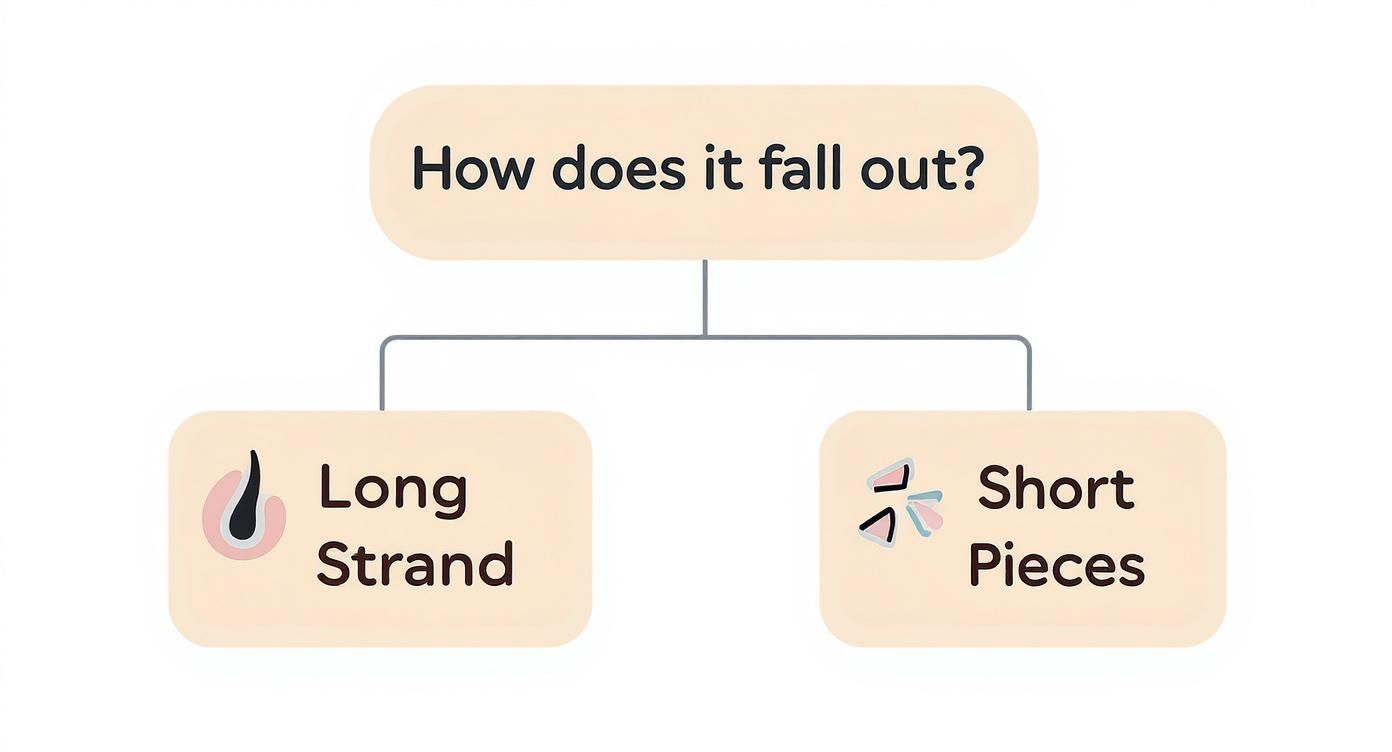
The takeaway is simple: a full-length strand with a bulb at the end is just shedding. A short, broken piece without a bulb is a clear sign of damage.
Don't Forget Environmental and Internal Factors
It’s not just what you do to your hair, but also what your hair goes through every day. Environmental factors can be surprisingly harsh. Things like sun exposure can break down the proteins in your hair, while hard water can leave mineral deposits that make strands stiff and prone to snapping.
At its heart, hair breakage is all about a compromised hair shaft. Whether it's from friction, heat, or chemicals, the damage chips away at your hair's integrity until it just can't handle daily life anymore.
Understanding this is half the battle. Research has shown that wet hair is up to five times more prone to breakage than dry hair—a perfect example of why gentle handling is so important. Even a simple change, like consistently using a good conditioner, can cut down on friction and reduce breakage by as much as 25%.
Once you've identified your hair's specific triggers, you can finally start building a routine that protects it and helps it thrive.
Building Your Anti-Breakage Hair Care Routine
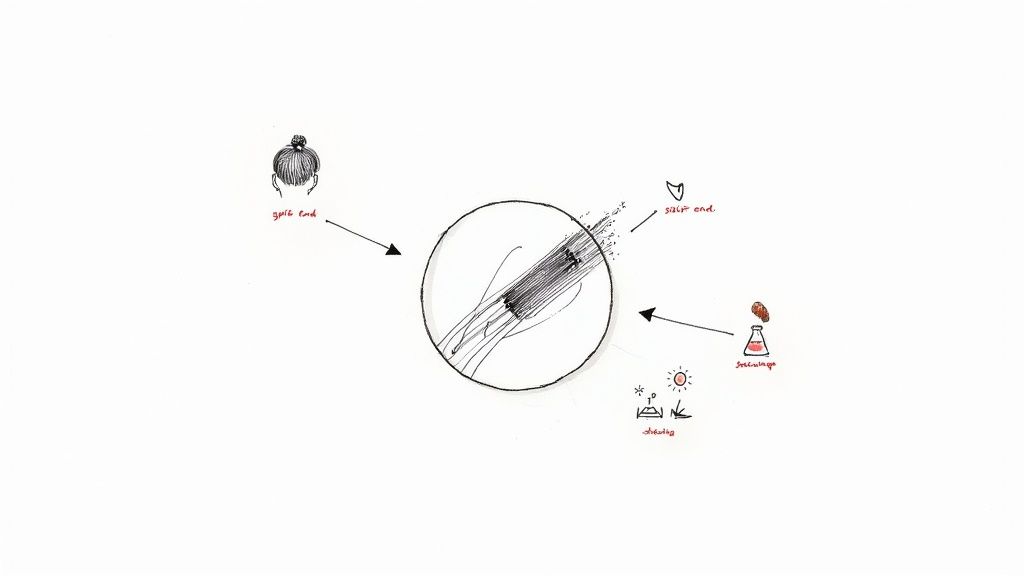
Knowing what’s causing your hair to snap is half the battle. The other half? Building a consistent routine that actually strengthens your hair from the inside out. This isn’t about a massive, overnight overhaul. It's about making small, smart swaps that build up a powerful defense against damage over time.
Think of it as creating a fortress around each strand. The foundation of that fortress is one simple principle: be gentle. Every single thing you do, from washing to styling, needs to be done with care to minimize stress on your already fragile hair. Shifting your mindset is the first real step to seeing lasting change.
Master Gentle Cleansing and Conditioning
Your wash day habits can either set you up for success or failure for the entire week. If you're scrubbing aggressively or using harsh, stripping cleansers, you’re practically inviting breakage by leaving your hair dry and brittle. The goal is to cleanse effectively without causing any collateral damage.
First, turn down the heat. Super hot water can lift the hair's cuticle, making it way more vulnerable. Stick to lukewarm water and gently massage a sulfate-free shampoo into your scalp using your fingertips—never your nails. The suds will cleanse the lengths of your hair as they rinse out; there’s no need to scrub your ends.
Conditioner is your non-negotiable ally against breakage. It smooths the hair's outer layer, which cuts down on friction and makes detangling a breeze. Be generous with it, concentrating on the mid-lengths and ends where hair is oldest and most fragile. Let it sink in for a few minutes before rinsing to really let it work its magic.
The Art of Damage-Free Detangling
This is where so many of us go wrong. Ripping a brush through knots, especially when your hair is wet and at its weakest, is a recipe for disaster. Patience and the right tools are everything here.
Always start from the bottom. Begin detangling at the ends and slowly, gently work your way up to the roots, section by section. This simple trick stops you from dragging a tiny knot all the way down the hair shaft and turning it into a massive, damaging tangle. A wide-tooth comb or a brush specifically designed for wet hair will be your best friend.
Pro Tip: Never, ever try to detangle bone-dry hair. If you need to brush between washes, give your hair a light mist of water or a leave-in conditioner first. This adds "slip," letting the comb glide through instead of snagging and snapping strands.
If your hair is especially prone to tangles, try a pre-shampoo treatment. Applying a little conditioner or hair oil to your dry hair before you even step into the shower can make the whole washing and detangling process unbelievably smoother.
Deep Conditioning for Intensive Repair
Your daily conditioner is for maintenance, but a weekly deep conditioning treatment is your secret weapon for serious repair. These masks are packed with concentrated ingredients that go deep into the hair shaft to restore moisture and rebuild strength where it counts.
Choose a mask that targets your specific problem. If your hair feels like straw, you need a hydrating mask with ingredients like hyaluronic acid or aloe vera. If it feels mushy or overly stretchy (a classic sign of over-processing), reach for a protein treatment with keratin or amino acids to patch up its structure.
Make Your Mask Treatment Count:
- Apply to Clean, Damp Hair: After shampooing, gently squeeze out the excess water. A microfiber towel is great for this.
- Get Even Coverage: Work the product through your mid-lengths and ends. Use a wide-tooth comb to make sure every strand gets some love.
- Turn Up the Heat: Pop on a shower cap to trap your body heat. This helps open the hair cuticle so the mask can penetrate deeper.
- Let It Sit: Give it at least 15-20 minutes (or whatever the directions say) to work. Rinse with cool water to seal the cuticle and lock in all that goodness.
Making this a non-negotiable weekly ritual gives your hair a consistent dose of fortification, which will dramatically reduce breakage over time. It’s a small time investment that pays off big.
The Best Ingredients and Supplements for Strong Hair

While a gentle hair care routine is your first line of defense against breakage, what you put on and in your body provides the actual building blocks for strong, resilient hair. Think of it this way: your routine protects the hair you already have, while the right ingredients and nutrients build better, stronger hair for the future.
Strengthening your hair is truly an inside-out job. Topical treatments can patch up weak spots and smooth down the cuticle for a quick fix, but genuine, long-term strength comes from the nutrients delivered directly to the follicle.
Let's break down the powerhouse ingredients that make a real difference, both on the surface and from within.
Topical Ingredients to Look For
When you're scanning product labels, a few key ingredients are dead giveaways that a formula is designed for serious repair and fortification. These are the players that work directly on the hair shaft to provide immediate support.
- Keratin: This one's a no-brainer. Your hair is made of about 95% keratin, a tough, fibrous protein. Products with hydrolyzed keratin can temporarily fill in the microscopic gaps and cracks in your cuticle, making hair feel instantly smoother and stronger.
- Ceramides: Think of these as the "glue" holding your hair's cuticle cells together. These lipids (fats) help flatten the cuticle, which is key for boosting shine and, more importantly, reducing the friction between strands that leads to tangles and snaps.
- Amino Acids: As the literal building blocks of protein, amino acids like arginine and cysteine are small enough to penetrate the hair shaft. Once inside, they help rebuild and reinforce its internal structure from the core.
The main goal of topical treatments is to beef up your hair's external defenses. By smoothing the cuticle and patching up weak points, these ingredients reduce the daily wear and tear that leads to breakage.
Finding products with these components can give your fragile hair the immediate boost it needs while you work on building foundational strength from within. It’s a powerful two-pronged approach to stop breakage in its tracks.
Fueling Your Hair from Within
Honestly, no amount of deep conditioning masks can make up for a diet that's lacking the fundamental nutrients for hair growth. Your nutritional status is a massive factor in preventing breakage.
Deficiencies in key vitamins and minerals are directly linked to increased fragility. For instance, iron deficiency—which affects an estimated 1.62 billion people globally—is a well-known cause of hair thinning and weakness. It’s no surprise that supplements now account for nearly 65% of sales in the hair thinning market.
So, what should you be eating?
- Protein: Since hair is protein, a lack of it in your diet forces your body to ration what it has, and hair growth is not high on the priority list. Make sure you're getting enough from lean meats, fish, eggs, legumes, and tofu.
- Iron: This mineral is absolutely crucial for producing hemoglobin, which carries oxygen to your cells—including the ones that power your hair follicles. Low iron can literally starve the follicles, leading to weaker, thinner strands.
- Biotin (Vitamin B7): Famous for its role in hair health, biotin is essential for producing keratin. You can find it in foods like eggs, almonds, and sweet potatoes.
Vitamins C and E are also key players. Vitamin C is vital for collagen synthesis (the "scaffolding" for your follicles), and Vitamin E is a powerful antioxidant that helps reduce scalp-damaging oxidative stress.
Hair Strengthening Nutrients vs. Topical Ingredients
It's easy to get confused about what works on the inside versus the outside. Here’s a quick comparison to clarify where different ingredients do their best work.
| Nutrient/Ingredient | How It Helps | Food Source / Product Type |
|---|---|---|
| Protein (Diet) | Provides the fundamental building blocks (amino acids) to create strong keratin. | Lean meats, fish, eggs, legumes, tofu. |
| Keratin (Topical) | Temporarily fills in cracks in the hair cuticle, smoothing and strengthening it. | Shampoos, conditioners, hair masks, leave-in treatments. |
| Iron | Crucial for oxygen delivery to hair follicles, supporting healthy growth cycles. | Red meat, spinach, lentils, fortified cereals. |
| Ceramides | Acts as a "glue" to hold cuticle cells flat, reducing friction and adding shine. | Leave-in conditioners, serums, hair oils. |
| Biotin | Aids in the production of keratin, the protein that makes up your hair. | Eggs, nuts, sweet potatoes, supplements. |
| Amino Acids | Penetrates the hair shaft to reinforce its internal structure. | Repairing treatments, protein masks, some conditioners. |
| Vitamin C | Essential for building collagen, which strengthens hair follicles and prevents loss. | Citrus fruits, bell peppers, strawberries, supplements. |
As you can see, a holistic approach that combines a nutrient-rich diet with targeted topical care gives your hair the best chance at becoming truly strong and resilient.
The Role of Targeted Supplementation
Even with a perfectly balanced diet, it can be tough to consistently get the optimal levels of every single nutrient your hair craves. This is where targeted supplementation can bridge the gap, delivering a concentrated dose of the specific compounds needed for robust hair growth.
Supplements designed for hair health usually combine these essential vitamins and minerals with other powerful compounds. For instance, many formulas focus on supporting your body's own collagen production—a process fundamental to tissue strength everywhere, including at the hair follicle.
Exploring options like plant-based collagen supplements is a great way to give your body the precursors it needs—like specific amino acids and vitamin C—to build its own strong, healthy hair structure without relying on animal sources. This approach fuels your body's internal machinery to create resilient hair right from the start.
Smart Styling Habits to Prevent Damage
How you handle your hair every day can either be a primary source of damage or your best line of defense against it. So many of the habits we’ve picked up over the years—cranking the flat iron up to its highest setting or yanking our hair back into a super-tight ponytail—are the direct culprits behind the very breakage we’re trying to stop.
The good news? You don't have to completely ditch your favorite looks. It's all about making small, intentional choices that are gentler on your strands day in and day out.
Rethinking Your Relationship with Heat
Let's be honest: heat styling is probably the number one offender when it comes to creating brittle, snap-prone hair. The intense temperatures from blow dryers, straighteners, and curling wands quite literally cook the protein structure of your hair, leading to damage that you just can't undo.
While going completely heat-free is the dream scenario for hair health, it’s not realistic for most of us. The key is to style smarter and make protection a non-negotiable part of your routine.
-
Always Use a Heat Protectant: This is the golden rule, and it's not one you should ever break. A good heat protectant spray creates a shield between your hair and the hot tool, helping distribute the heat more evenly and slowing down heat conduction to minimize the damage.
-
Turn Down the Temperature: You probably don't need to use the highest setting. Most hair types can be styled perfectly well between 300-375°F (150-190°C). Start on a lower setting and only bump it up if you really need to.
-
One Pass Is Enough: When you're straightening your hair, try to make each pass slow, smooth, and deliberate. Running the iron over the same section again and again is what fries the cuticle and leads to those dreaded split ends.
Making these simple adjustments can dramatically reduce the daily wear and tear on your hair, allowing it to grow stronger and longer.
The Power of Protective Hairstyles
A "protective style" is simply any hairstyle that keeps your fragile ends tucked away, shielding them from the friction and environmental stress of daily life. This doesn't have to mean intricate, time-consuming braids, either. Even simple styles can make a massive difference.
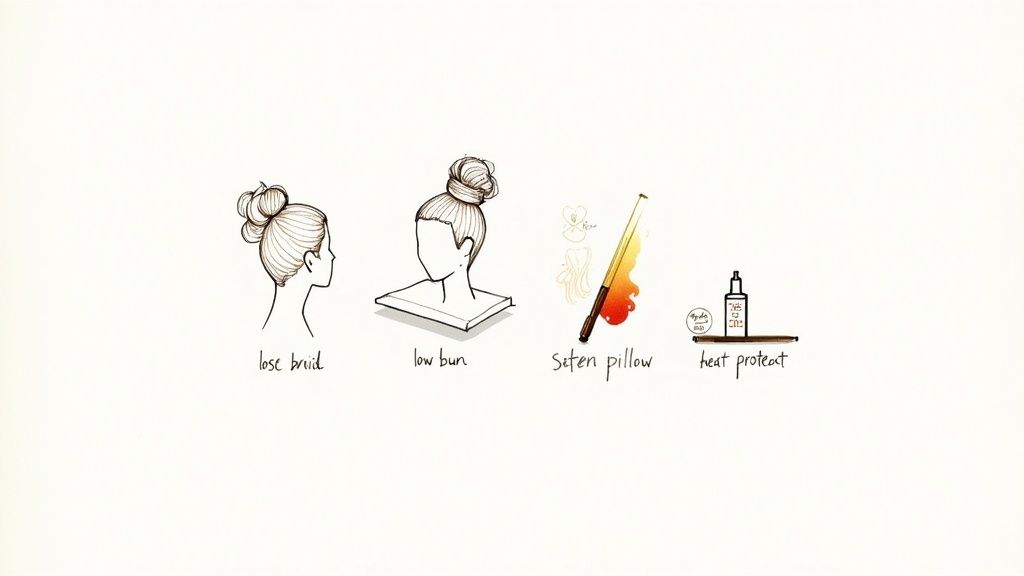
Think loose buns secured with gentle hair ties, soft braids that aren't pulled tightly at the scalp, or elegant twists. The main goal is to prevent your ends from constantly rubbing against your clothes, your office chair, or your pillowcase, which wears them down over time.
A quick but important note: the key to a truly protective style is that it must be low-tension. Any style that pulls on your scalp or feels uncomfortably tight is doing more harm than good and can even lead to traction alopecia.
For anyone trying to grow longer, healthier hair, embracing loose, protective styles can be a total game-changer. It’s a simple habit that also helps in the quest for fuller-looking hair. You can explore more strategies for this in our comprehensive guide on how to make hair thicker.
Choosing Hair-Friendly Accessories
The little things you use to hold your hair back can be your best friend or your worst enemy. So many of the common hair ties and clips out there are made with materials that snag, pull, and literally tear at your hair shaft.
Making a few smart swaps in your accessory drawer is one of the easiest wins you can get in the fight against mechanical breakage.
| Ditch This Accessory | Choose This Instead | Why It's Better |
|---|---|---|
| Traditional elastic ties with metal clasps | Silk or satin scrunchies | The metal piece snags and rips hair, while the smooth fabric of a scrunchie allows hair to glide without friction. |
| Rubber bands | Spiral (coil) hair ties | Rubber grips hair way too tightly, causing a distinct line of breakage. Coils distribute pressure unevenly to avoid this. |
| Bobby pins with missing plastic tips | Smooth, coated bobby pins or U-pins | Those exposed metal ends can scrape and shred the hair cuticle. U-pins offer a gentler hold for buns and updos. |
| Tight, rigid headbands | Soft, fabric headbands | A tight headband can cause constant friction and breakage right at your hairline, especially over time. |
Even what you sleep on matters. Swapping your cotton pillowcase for a silk or satin one seriously reduces friction overnight, meaning fewer tangles and less breakage while you sleep. It's a small investment that pays off big time for your hair's health.
When to See a Professional for Hair Breakage
So, you’ve done it all. You’ve got the silk pillowcase, you’re a pro at gentle detangling, and your weekly deep conditioning treatment is practically a sacred ritual. But what if your hair is still snapping? Sometimes, no matter how much you do at home, the breakage just won't quit. That's when it's time to call in the professionals.
Knowing when to pass the baton to an expert is a huge part of getting your hair back on track. If the breakage is severe or just won't let up, it could be a sign of something more complex than heat damage or a tight ponytail. A trained eye can offer a diagnosis and solutions you simply can't find in a bottle.
When At-Home Solutions Fall Short
It’s one thing to deal with a few split ends when you’re overdue for a trim. It's a whole other ball game when the breakage feels relentless. If you’ve been sticking to a solid anti-breakage routine for weeks and aren't seeing any real improvement, that's your cue to seek expert help.
Be on the lookout for these red flags:
- Sudden or Extreme Breakage: If your hair abruptly starts breaking off in handfuls without any clear reason, it’s time for a professional opinion.
- Noticeable Thinning: Is your ponytail feeling a lot skinnier than it used to? When breakage is so widespread that it’s affecting your overall density, that's a serious concern.
- Unusual Scalp Issues: Breakage that comes with an itchy, red, flaky, or painful scalp often points to an underlying condition that needs a specialist's diagnosis.
Ignoring these signs can let the problem spiral, making the damage much harder to reverse down the line. A pro can help you get ahead of it before it becomes a bigger battle.
Your Team of Hair Health Experts
When you decide it’s time for help, you have a few options. The right expert for you really depends on what you think is at the root of the problem.
A hairstylist is your first line of defense, especially if you suspect the damage is from styling or chemical treatments. They can take a close look at your hair's structural integrity, recommend powerful in-salon treatments, and give you a strategic haircut to snip off damage and stop splits from traveling up the hair shaft.
A trichologist is a hair and scalp specialist. Think of them as a detective for your hair. They can do a deep-dive analysis to identify disorders or underlying causes of hair loss and breakage that go way beyond simple wear and tear.
Finally, a dermatologist is a medical doctor who handles conditions of the skin, hair, and nails. If you have a gut feeling your hair breakage is tied to a medical issue—like a vitamin deficiency, hormonal shift, or an autoimmune condition—a dermatologist is the right person to see.
Uncovering Underlying Medical Causes
Sometimes, what looks like a problem on the outside is really a signal from the inside. Your hair is often a surprisingly accurate barometer of your overall health, and persistent breakage can be your body’s way of telling you something is off.
Several health conditions are known to affect hair:
- Thyroid Disorders: Both an underactive (hypothyroidism) and overactive (hyperthyroidism) thyroid can make hair dry, brittle, and incredibly prone to snapping.
- Nutritional Deficiencies: A serious lack of key nutrients like iron, zinc, or protein can sabotage your body's ability to build strong keratin, leaving you with weak, fragile strands.
- Hormonal Fluctuations: Major life events like pregnancy and menopause, or conditions like Polycystic Ovary Syndrome (PCOS), can throw your hair’s growth cycle and strength completely out of whack.
A dermatologist can run blood tests to pinpoint these kinds of issues. Getting a proper medical diagnosis is critical because, in these cases, no amount of deep conditioner is going to fix the root cause. The only way to truly stop the breakage for good is to treat the underlying health condition.
Professional-Grade Treatments and What to Expect
One of the biggest perks of seeing a professional is getting access to powerful treatments you just can't buy off the shelf. Think salon-grade bond-building systems that use patented molecules to get inside the hair shaft and actually repair the broken disulfide bonds that give your hair its strength and structure.
When you go in for a consultation, be ready to talk about everything—your hair history, your diet, your lifestyle. The more info you can share, the better. Come prepared with a list of questions, like what specific treatments they recommend and why, and what kind of results and timeline you can realistically expect. It’s a team effort, and taking an active role is the best way to get your hair back to its healthiest state.
Your Top Hair Breakage Questions, Answered
Even when you’ve got a game plan, a few nagging questions can pop up. Let’s tackle some of the most common ones I hear about stopping hair breakage, so you can feel totally confident in your routine.
Think of this as your go-to guide for those "what if" moments on your journey back to healthy hair.
Can Certain Hairstyles Really Stop Breakage?
They absolutely can, but the secret is in how you style, not just what style you choose. The goal is to go for loose, low-tension looks that keep your fragile ends safely tucked away. This protects them from the constant friction of rubbing against your clothes, your couch, or your pillowcase at night.
A few great options are:
- Loose Braids: Simple, classic braids that aren’t yanked tight at the scalp are amazing for minimizing tangles and shielding the hair shaft.
- Soft Buns or Twists: Gently gathering your hair into a bun—and using a silk scrunchie instead of a tight elastic—is a perfect way to keep ends protected without creating stress.
- The Pineapple: This is a lifesaver for curly types. It's just a very loose, high ponytail right on top of your head that you sleep in to protect your curl pattern and prevent friction.
On the flip side, any style that pulls relentlessly on your scalp is a fast track to damage. Things like super-tight braids, weaves, or ponytails can lead to traction alopecia. That’s a form of hair loss caused by constant tension, which is a much bigger issue than simple breakage.
Is It Really Possible to Repair Split Ends?
This question comes up all the time, and I'll give you the honest truth: no, you can't permanently "heal" a split end. Once that hair shaft has frayed, it's frayed for good. Those "split end mender" products are a temporary fix—they use ingredients to basically glue the split pieces back together, but it all washes out the next time you shampoo.
The only real, lasting solution for split ends is a haircut. Getting regular trims every 6-8 weeks is the best way to stop those splits from traveling further up the hair shaft, where they'd cause even more breakage. Don't think of it as losing length; think of it as protecting the healthy, beautiful hair you already have.
Does Stress Actually Contribute to Hair Breakage?
While stress won't make a hair strand snap in half on its own, it definitely creates an environment where breakage is far more likely to happen. In severe cases, chronic stress can trigger a condition called telogen effluvium, where a shocking number of hairs enter the shedding phase all at once. The new hair that eventually grows back can be weaker and more fragile.
But more often than not, stress messes with our habits. When we're overwhelmed, we tend to let our healthy routines slide, eat poorly, or even start unconsciously twisting or pulling at our hair—all things that weaken our strands over time.
Learning to manage stress with things like mindfulness, a good workout, or just getting enough sleep isn't just a mental health practice. It’s a non-negotiable part of any holistic hair care plan.
How Long Will It Take to See Less Breakage?
This is where patience becomes your best friend. You'll probably feel a difference almost immediately—after just one or two deep conditioning treatments, your hair will likely feel softer and be easier to detangle. But seeing a real, significant drop in breakage takes time, because you're essentially waiting for new, stronger hair to grow in.
Here's a realistic timeline to keep in mind:
- 1-2 Weeks: Your hair will feel much softer and more hydrated.
- 1-2 Months: You should start to see a noticeable reduction in the little broken hairs on your clothes or in your brush.
- 3-6 Months: This is the magic window where the benefits of your new routine, diet, and supplements really start to show as healthier, more resilient hair makes its debut.
Consistency is what makes the difference. Sticking to your gentle routine, nutrient-packed diet, and smart styling habits is what builds strong, beautiful hair for the long haul. It truly is a marathon, not a sprint.
Ready to fuel stronger, more resilient hair from the inside out? Staye offers a clean, plant-based way to support your body's natural collagen production, providing the essential building blocks for healthier hair, skin, and nails.
Discover how Staye can complete your hair wellness routine today!