

If you're serious about boosting your collagen naturally, it all comes down to a three-pronged approach. You need to focus on a diet loaded with vitamin C, amino acids, and key minerals. At the same time, you have to adopt lifestyle habits that protect the collagen you already have. Finally, adding targeted topical treatments can give your skin the signal to ramp things up.
It’s about working from the inside out and the outside in.
Your Quick Guide to Boosting Collagen Naturally
Think of collagen as the structural scaffolding for your entire body. It makes up a whopping 30% of your body's total protein, giving your skin, bones, and tendons their strength and form.
The catch? Our natural production starts to drop off as early as our mid-20s. On top of that, things like sun exposure, pollution, and even stress can speed up its breakdown. So, the goal isn't just to make more collagen—it's to protect what we've got.
The good news is that we have a lot of control over this process.
- Nutrition: Foods rich in vitamin C and amino acids are the literal building blocks your body needs for collagen synthesis.
- Lifestyle: Simple habits like wearing sunscreen, managing stress, and getting quality sleep are your best defense for preserving existing collagen fibers.
- Topical Care: Certain ingredients, like retinoids and peptides, can actually communicate with your skin cells and encourage them to produce more collagen.
A Practical Blueprint for Healthier Skin
This guide is designed to cut through the noise and give you practical, actionable tips you can start using today. No fluff, just what works.
As you explore each section, you'll find everything from meal ideas and lifestyle tweaks to specific skincare routines that deliver real results.
To make things even clearer, here’s a quick overview of the core strategies we'll be covering. Think of this as your cheat sheet for building a solid, collagen-friendly routine.
Summary of Natural Collagen Boosting Strategies
| Strategy | Key Benefits | Example Foods or Practices |
|---|---|---|
| Nutrition | Provides the essential building blocks for new collagen. | Citrus fruits, berries, lean proteins, bone broth, leafy greens. |
| Lifestyle | Shields existing collagen from damage and degradation. | Daily sunscreen (SPF 30+), meditation, 7-9 hours of sleep. |
| Topical Care | Directly stimulates skin cells to ramp up collagen synthesis. | Serums with retinoids, vitamin C, peptides, or bakuchiol. |
Each of these pillars supports the others. For example, eating well gives your skin the fuel it needs, while a smart skincare routine helps put that fuel to work.
The most effective approach to supporting your collagen starts from within and is reinforced by smart, protective daily habits.
Putting these strategies together is what truly lays the groundwork for firmer, more resilient skin and stronger connective tissue throughout your body. I always suggest starting small—pick one new habit from the table above to try this week, then build from there.
How to Get Started Today
Ready to jump in? Here are a few simple things you can do right now to get the ball rolling.
- At Breakfast: Add a handful of berries or a sliced orange to your yogurt or oatmeal for a powerful vitamin C boost.
- For Snacks: Instead of reaching for something sugary, grab a small handful of pumpkin seeds or almonds. They provide zinc and amino acids crucial for collagen production.
- In Your Skincare Routine: Before applying sunscreen in the morning, smooth on a vitamin C serum. This duo works together to offer incredible protection against environmental damage.
From my own experience, consistency is what separates those who see results from those who don't. These small daily actions compound over time, leading to visible improvements in your skin's texture and firmness.
A Quick Real-World Example
I recently worked with a client, Emily, a 35-year-old runner who was starting to notice her skin wasn't bouncing back like it used to. We had her start her day with a citrus and spinach smoothie, use a gentle retinol in the evening, and commit to a 10-minute nightly meditation to wind down.
After just four weeks, she was amazed. The fine lines around her eyes had softened, and she said her skin felt more "bouncy" and hydrated after her long runs. It wasn't a complicated overhaul—just a few simple, consistent upgrades.
The best part is that you can adapt these strategies to fit any lifestyle, including vegan or vegetarian diets. It’s all about starting small, being patient with your body, and enjoying the process of building healthier skin from the inside out.
Why Does Collagen Production Decline?
Collagen is basically the scaffolding for your body. It’s a structural protein that gives your skin, joints, and connective tissues their strength and shape. And while it makes up about a third of all the protein in your body, its production starts to dip surprisingly early—as soon as our twenties.
By the time you hit midlife, that gradual decline really starts to show, often as less firmness in the skin and more noticeable wrinkles.
The Impact of Aging on Collagen
It all starts with our fibroblasts. These are the tiny "collagen factories" in our cells, and as we get older, they just don't work as hard as they used to. On a cellular level, the tightly organized, strong network of collagen fibers begins to look more like a disorganized maze.
This structural breakdown is exactly what leads to reduced skin elasticity, fine lines, sagging, and even slower healing from injuries.
Several factors can put this process into overdrive:
- Sun exposure: UV radiation is collagen’s number one enemy. It actively breaks down collagen fibers and stops your body from making new ones.
- Smoking: Tobacco smoke unleashes a flood of free radicals that directly attack and weaken your collagen structures.
- High-sugar diets: Sugar leads to a process called glycation, where sugar molecules attach to collagen, making it stiff, brittle, and damaged.
- Pollution: Environmental toxins expose your skin to oxidative stress, which is like a fast-forward button for collagen breakdown.
On top of all that, things like chronic stress, not getting enough quality sleep, and heavy alcohol consumption throw a wrench in your body's natural repair cycles.
Hormonal and Cellular Drivers
Hormones play a huge role here, too. As our hormone levels shift throughout life, particularly cortisol and estrogen, collagen production takes a hit.
Chronic stress is a big one. It keeps your cortisol levels high, and cortisol is known to degrade the very fibroblasts that are supposed to be building collagen. At the same time, the drop in estrogen that comes with menopause is a major accelerator for collagen loss, leading to a noticeable decrease in skin density and elasticity.
Research from the American Academy of Dermatology shows that women can experience up to a 30% loss of collagen in the first five years after menopause.
This isn’t just a midlife issue. The data shows collagen naturally declines by about 1% each year starting in our late twenties. You can dive deeper into the research on collagen decline on Optimadermatology to see why taking proactive steps is so important.
Environmental Stress and Aging
Think of pollutants and UV rays as a constant attack on your collagen. They generate free radicals—unstable molecules that damage healthy cells and proteins. Over time, this cellular stress overwhelms your body’s ability to repair itself, speeding up the visible signs of aging.
Experts estimate that consistent, daily sun protection can prevent up to 50% of the damage that leads to collagen degradation.
This shows just how much power we have with simple, daily habits. I once worked with a photographer in her thirties who spent years shooting outdoors without much sun protection. She came to me concerned about her pronounced sunspots and fine lines. We got her started on a daily SPF 30 and a good vitamin C serum, and within two months, she was amazed at how much clearer and more resilient her skin looked.
What This Means for Your Joints and Connective Tissue
While your skin is where you see collagen loss most obviously, your joints and tendons feel it.
Less collagen in your connective tissues can translate to morning stiffness, nagging aches, slower recovery from exercise, and even a higher risk of injury. The internal scaffolding just isn't as strong as it used to be.
| Feature | Youthful Collagen | Aged Collagen |
|---|---|---|
| Fiber Organization | Tightly aligned network | Disorganized, tangled maze |
| Elasticity | High resilience and bounce | Reduced flexibility and snap |
| Fibroblast Activity | Robust and active production | Slowed, sluggish synthesis |
Once you understand how the structure changes, it becomes clear why a multi-pronged approach is the only way to go. You need strategies that both shield the collagen you still have and encourage your fibroblasts to get back to work.
- A nutrient-rich diet gives your body the raw materials it needs.
- Smart skincare defends against UV rays and environmental damage.
- Managing stress and prioritizing sleep helps keep your hormones in balance.
- Regular, moderate exercise boosts circulation and supports cellular health.
These are the pillars of any effective plan to naturally boost your collagen.
The Key Takeaways
- Collagen decline starts early (in your 20s!) and picks up speed over time.
- Women often experience a sharper drop after menopause due to hormonal shifts.
- Sun, smoking, and sugar can drastically accelerate the breakdown process.
- Stress and poor sleep sabotage your body’s natural repair and production.
- Understanding why it happens is the first step to doing something about it.
Now that you know what you're up against, you’re ready to learn how to protect and rebuild your body's collagen network. Next, we'll get into the practical, actionable nutrition and lifestyle strategies you can start using today.
Fueling Collagen From the Inside Out
Your body is an incredible machine, constantly building and repairing itself. To create something as complex as collagen, it needs the right raw materials, and the only place to get them is from your food.
Think of nutrition as the absolute foundation of any effective collagen-boosting plan. While supplements and fancy creams can play a supporting role, they're pretty useless if your body doesn't have the fundamental nutritional building blocks it needs to run its collagen-making machinery in the first place.
The Essential Building Blocks for Collagen
Collagen isn't just one thing. It's a highly specific protein built from a chain of amino acids, and two of them—glycine and proline—are especially critical. Without a steady supply of these, your body simply can't kick off the synthesis process.
But the amino acids are just the start. Certain vitamins and minerals act like the skilled "workers" on the assembly line, putting those building blocks together to form strong, resilient collagen fibers. This is where a smart, nutrient-dense diet becomes your most powerful tool.
The best strategy isn't about chasing one magical "superfood." It's about creating a consistent dietary pattern that gives your body every single component it needs to do its job well.
This infographic gives a great visual breakdown of the key lifestyle factors that work directly against your body's collagen-producing efforts.
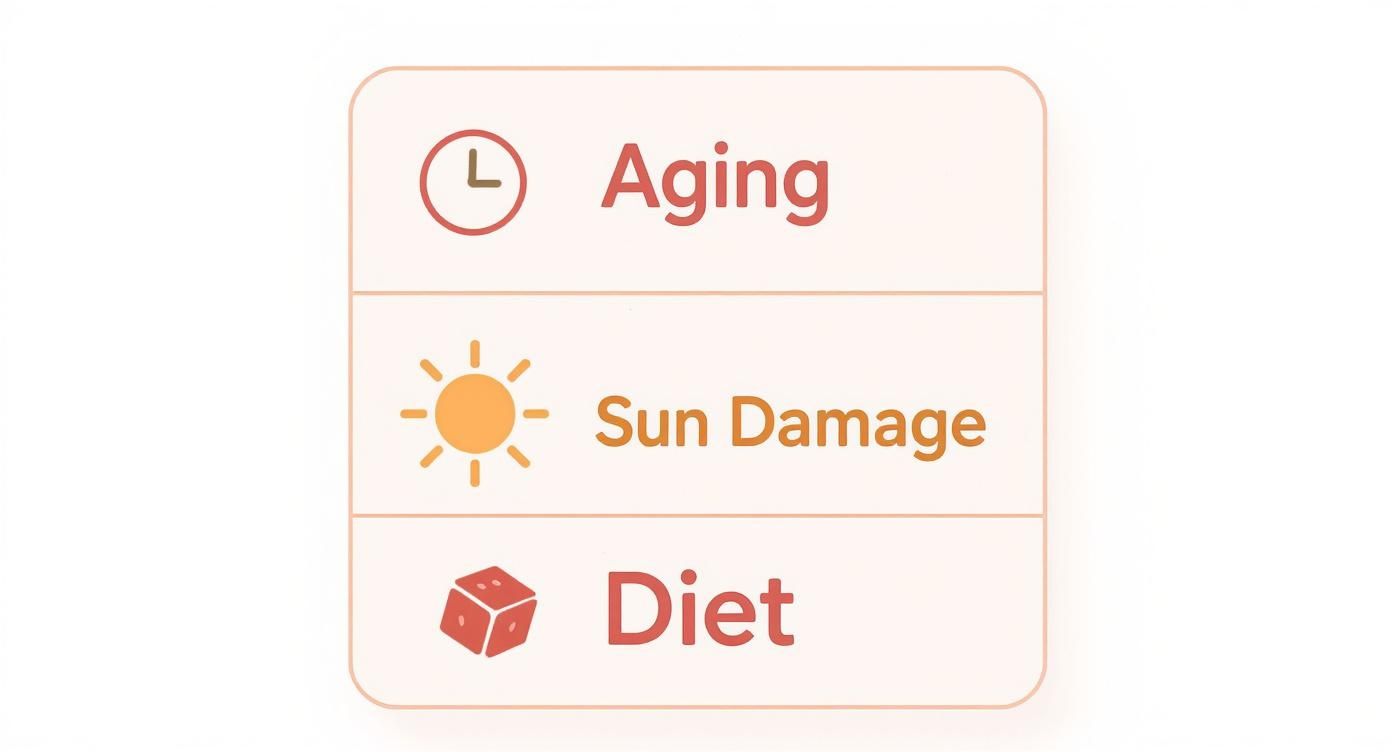
As you can see, the combination of aging, sun exposure, and a poor diet is a perfect storm for accelerated collagen decline.
Your Collagen-Boosting Shopping List
Don't worry, creating collagen-supportive meals doesn't have to be complicated. It all comes down to focusing on whole foods that are naturally packed with the necessary amino acids and their essential co-factors.
Here’s a quick-and-dirty breakdown of what to load up on:
- Amino Acid Sources: The primary building blocks—glycine, proline, and lysine—are most concentrated in protein-rich foods. Think poultry, fish, grass-fed beef, eggs, and dairy. If you're plant-based, you can get high-quality sources from soy (tofu, tempeh), legumes, and certain nuts and seeds.
- Vitamin C Powerhouses: This vitamin is completely non-negotiable. It’s the critical co-factor that helps link those amino acids together to form strong collagen fibrils. Fill your plate with citrus fruits, bell peppers, broccoli, strawberries, and leafy greens like kale.
- Zinc-Rich Foods: Zinc is another vital co-factor in the collagen synthesis process. You can find it in shellfish (oysters are a fantastic source), nuts, seeds, beans, and whole grains.
- Copper-Containing Foods: Copper plays a key role in forming the final structure of collagen, giving it the strength and stability it needs to function properly. Great sources include shiitake mushrooms, cashews, sesame seeds, and dark leafy greens.
What's really cool is how these nutrients work together. For instance, eating a vitamin C-rich food alongside a protein source gives your body a leg up, enhancing its ability to use those amino acids for collagen repair.
Key Nutrients for Collagen Synthesis
To really understand what your body needs, it helps to see the key players laid out. This table breaks down the most important vitamins, minerals, and amino acids for collagen formation, along with where to find them and how much you should aim for.
| Nutrient | Role in Collagen | Top Food Sources | Suggested Daily Amount |
|---|---|---|---|
| Vitamin C | Essential co-factor for converting proline into hydroxyproline, stabilizing the collagen structure. | Bell peppers, citrus fruits, strawberries, broccoli, kiwi, kale. | 90 mg (men), 75 mg (women) |
| Glycine | The most abundant amino acid in collagen; provides structural foundation. | Bone broth, gelatin, pork/chicken skin, fish, legumes. | No RDA; aim for ~10-15g total protein intake |
| Proline | A key amino acid that forms the collagen helix structure. | Egg whites, dairy, cabbage, mushrooms, asparagus. | No RDA; obtained through adequate protein intake |
| Zinc | Acts as a co-factor for enzymes that produce collagen. | Oysters, red meat, poultry, beans, nuts, whole grains. | 11 mg (men), 8 mg (women) |
| Copper | Helps create cross-links between collagen fibers, providing strength and elasticity. | Shellfish, nuts, seeds, shiitake mushrooms, leafy greens. | 900 mcg |
| Antioxidants | Protect existing collagen from damage by neutralizing free radicals. | Berries, dark chocolate, green tea, pecans, artichokes. | No RDA; focus on a variety of colorful plants. |
Think of this table as your nutritional cheat sheet. By consistently including these foods in your diet, you're not just eating—you're actively supplying your body with the precise tools it needs to maintain and build healthy collagen.
Putting It All Together: A Sample Day
So, what does this look like on a real plate? Here’s an example of a day designed to fuel your collagen factory from morning to night.
- Breakfast: A smoothie with spinach (vitamin C, copper), Greek yogurt (proline, glycine), and a handful of strawberries (vitamin C, antioxidants).
- Lunch: A big salad with grilled chicken or chickpeas (protein, zinc), topped with sliced bell peppers (vitamin C) and a lemon-tahini dressing (copper).
- Snack: A small handful of cashews and an orange.
- Dinner: Baked salmon (omega-3s) with a side of roasted broccoli (vitamin C) and quinoa (protein).
This isn't about a restrictive diet. It's about making smart, deliberate choices that give your body exactly what it needs to thrive.
If you want to explore more meal ideas and get even more specific, check out our comprehensive guide on foods that support collagen production for a deeper dive.
Lifestyle Habits That Protect and Enhance Collagen
While a great diet gives you the raw materials to build collagen, your daily habits are what truly decide if your body can use them effectively. Think of your lifestyle as the ultimate gatekeeper for your skin's structural integrity. Even the most perfect diet can be completely undermined by habits that actively tear down your collagen reserves.
Learning how to boost collagen naturally is just as much about preventing damage as it is about building new fibers. The good news is that simple, consistent daily choices can make a huge difference in your skin's health, firmness, and resilience over the long haul.
Master Your Stress Response
Chronic stress is the silent saboteur of great skin. When you're constantly on edge, your body floods your system with the hormone cortisol. This stuff is notorious for breaking down collagen and elastin, fast-tracking the arrival of wrinkles and sagging skin.
Getting a handle on your stress is a non-negotiable for any serious pro-collagen plan. It’s not about eliminating stress—that's impossible. It's about building routines that help your nervous system recover and find its balance.
- Mindful Moments: Just 5-10 minutes of daily meditation or deep breathing exercises can dramatically lower cortisol levels.
- Gentle Movement: Activities like yoga or even a quiet walk outside help shift your body out of that constant "fight or flight" state.
- Digital Detox: Putting your screens away, especially an hour before bed, gives your brain a much-needed chance to unwind and reset.
I once worked with a client in a high-pressure job who was seeing rapid, unwelcome changes in her skin. We didn't add a bunch of new products; instead, we focused on creating a simple 15-minute "wind-down" routine before sleep. Within a month, she told me her skin looked less reactive and felt fundamentally calmer.
A consistent stress-management practice is one of the most powerful—and overlooked—strategies for preserving your collagen. It directly counteracts the hormonal cascade that accelerates skin aging.
This proactive approach helps create an internal environment where your collagen can thrive, rather than constantly being under attack.
Prioritize Restorative Sleep
Sleep is when your body's repair crew clocks in for the night shift. During your deepest sleep cycles, your body releases human growth hormone (HGH), which is absolutely essential for repairing damaged cells and firing up collagen synthesis.
When you consistently skimp on sleep, you're robbing your body of this critical repair window. And the goal isn't just any sleep; it's high-quality, restorative sleep. Aim for 7-9 hours a night.
A few tweaks to your sleep hygiene can make all the difference:
- Stick to a Schedule: Try to go to bed and wake up around the same time each day, even on the weekends. Your body loves rhythm.
- Optimize Your Environment: A cool, dark, and quiet bedroom sends a powerful signal to your body that it's time for deep rest.
- Cut Evening Blue Light: Ditch the phone and laptop for at least an hour before you plan to sleep. That blue light is a known disruptor of melatonin, your natural sleep hormone.
Make Sun Protection a Daily Ritual
UV radiation from the sun is, without a doubt, the single biggest external enemy of your collagen. It works in two terrible ways: it fires up enzymes that literally chew through your existing collagen fibers, and it damages the very cells (fibroblasts) responsible for making new ones.
Your best defense is daily, non-negotiable sun protection. And I don't just mean for beach days—I mean every single day, whether it's sunny or overcast.
Make a broad-spectrum SPF 30 or higher the final step of your morning skincare routine, no exceptions. This simple habit prevents the slow, steady UV damage that accumulates over the years and visibly speeds up aging. Sun protection is a cornerstone of any effective plan, especially if you're also exploring ways how to tighten loose skin through other methods.
Embrace Collagen-Friendly Exercise
The right kind of movement does more than just keep you fit; it's a direct investment in your skin's health. Exercise revs up circulation, delivering a fresh supply of oxygen and nutrients straight to your skin cells—including those all-important fibroblasts.
Certain types of exercise seem to be particularly helpful:
- Strength Training: Lifting weights or using your own bodyweight for resistance creates tiny micro-tears in muscle and connective tissue. The repair process that follows can actually stimulate fibroblast activity and bolster collagen production.
- High-Intensity Interval Training (HIIT): Those short, powerful bursts of activity have been shown to support cellular health and kickstart your body's natural repair mechanisms.
The most important thing is finding something you actually enjoy, because consistency is everything. Whether it's a brisk walk, a dance class, or a weightlifting session, regular movement supports the entire ecosystem that keeps your skin firm, healthy, and resilient.
Targeted Topicals and Smart Supplementation
While building collagen from the inside out with great nutrition is non-negotiable, you can absolutely supercharge your results with the right topical treatments and oral supplements. This is where you get to work directly on the skin itself, giving it the specific signals and raw materials it needs to get busy.
Think of it this way: your diet provides the general construction materials, but topicals are like sending a foreman directly to the job site with specific instructions.
Skincare That Tells Your Skin to Make More Collagen
Some ingredients are true standouts, with years of research backing their ability to kickstart collagen synthesis right where you apply them. Adding these to your routine is one of the most direct ways to see a real difference in your skin's firmness and texture.
- Retinoids (Vitamin A): There's a reason every dermatologist recommends them. Retinoids, from prescription-strength tretinoin to over-the-counter retinol, are the undisputed champions of skin renewal. They work by boosting cell turnover and directly flicking the switch on collagen production. Be patient, though—it takes real consistency, often 3 to 6 months of steady use, to see those fine lines soften.
- Vitamin C Serums: This isn't just a protective antioxidant; it's a critical piece of the collagen-building puzzle. Topically, Vitamin C defends your existing collagen from UV and pollution damage. But just as importantly, it's a key cofactor your body needs to link amino acids together, forming those strong, resilient collagen fibers.
- Peptides: These little guys are short chains of amino acids that act like messengers. When you apply them to your skin, certain peptides can essentially trick it into thinking its collagen has been damaged, signaling it to rev up production and make more.
Pro Tip: If you're new to retinoids, ease into it. Start by applying a pea-sized amount just a few nights a week to let your skin adjust. Always, always follow up with a good moisturizer, and never skip sunscreen the next day—retinoids make your skin more sensitive to the sun.
Boosting Collagen From Within: The Role of Supplements
While topicals are working on the surface, smart supplementation can provide your body with a concentrated dose of the building blocks it needs. The supplement aisle can be overwhelming, but a few key players have solid science behind them for supporting skin health from the inside.
Collagen peptides, for instance, are a fantastic example. These are just small, broken-down pieces of collagen that are easy for your body to absorb and use. Clinical studies have shown that taking them daily can genuinely improve the density of your skin’s collagen network, leading to better hydration and elasticity. Similarly, other compounds like aloe vera sterols have been shown in studies to nearly double both hyaluronic acid and collagen levels in just 8 weeks. You can dive deeper into the science behind collagen-boosting supplements in our detailed guide.
These aren't just empty claims; the right supplements can deliver measurable results, especially when you combine them with a healthy diet. You can read more about the research behind collagen peptides and their effects on skin on nature.com.
When you’re shopping for a supplement, look for brands that are upfront about their ingredients and where they come from. A truly effective formula won’t just give you the building blocks; it will also include the co-factors (like Vitamin C!) that your body needs to actually put them to work.
Your Weekly Collagen-Boosting Action Plan

Alright, this is where the theory turns into action. We’ve covered a lot, but putting it all into practice is what really makes a difference. Let's map out what a simple, effective weekly schedule could look like.
Forget about perfection. This is all about finding a consistent rhythm that helps your body do what it does best: produce its own collagen. The idea is to build sustainable habits that eventually feel second nature.
Think of this as a flexible blueprint. You can—and should—mix and match everything here to fit your own life, tastes, and dietary needs.
A Sample 7-Day Meal Guide
Here’s a peek at what a week packed with collagen-friendly nutrients could look like. You'll notice every day is built around protein, vitamin C, zinc, and a healthy dose of antioxidants.
- Monday: Kick off the week with Greek yogurt topped with fresh strawberries and a handful of pumpkin seeds. For dinner, think baked salmon with a side of roasted broccoli.
- Tuesday: Blend up a citrus and spinach smoothie to start your day. Lunch could be a big lentil salad loaded with colorful bell peppers.
- Wednesday: Scrambled eggs with sliced avocado and tomato. For dinner, try a chicken stir-fry packed with cashews and a rainbow of veggies.
- Thursday: A warm bowl of oatmeal with berries and a sprinkle of chia seeds. At lunchtime, a quinoa bowl with black beans, corn, and a zesty lime dressing hits the spot.
- Friday: A quick protein shake with a scoop of plant-based protein and an orange. End the week with grass-fed beef tacos piled high with greens.
- Saturday: Simple whole-wheat toast with almond butter and banana slices. For dinner, a hearty, comforting vegetable soup made with a bone broth base.
- Sunday: A savory tofu scramble seasoned with turmeric and wilted leafy greens, followed by a cozy dinner of roasted chicken and sweet potatoes.
Vegan & Vegetarian Tip: It's easy to adapt this! Swap any animal proteins for quality plant-based options like tofu, tempeh, lentils, chickpeas, and quinoa. Just make sure you’re getting plenty of zinc from nuts and seeds, and you might want to look into a plant-based collagen booster supplement to provide the specific amino acids your body needs.
Integrating Skincare and Lifestyle Habits
What you do on the outside and how you live your day is just as crucial as what you eat. Here’s a simple routine to keep your skin and wellness habits on track.
Daily Must-Dos
- Morning: Every single day starts the same: cleanse, apply a vitamin C serum for that antioxidant shield, moisturize, and then—the most important step—finish with a broad-spectrum SPF 30+ sunscreen. No skipping this!
- Evening: Cleanse away the day (makeup, sunscreen, everything). This is the time for your heavy hitters like a peptide serum or a retinoid (start slow, just 2-3 times per week). Lock it all in with a good, rich moisturizer to support your skin barrier while you sleep.
- Mindfulness: Find 10-15 minutes for an activity that dials down your stress. This could be meditation, some deep breathing exercises, journaling, or even just a quiet walk without your phone.
Weekly Reminders
- Strength Training: Get in 2-3 sessions a week. Lifting weights is fantastic for stimulating circulation and keeping all your connective tissues healthy and strong.
- Exfoliation: Use a gentle exfoliant just 1-2 times a week. This helps slough off those dead skin cells so all your powerful serums and treatments can actually penetrate and get to work.
This is your starting point, not a rigid set of rules. The best plan is always the one you can actually stick with, so listen to your body, make adjustments, and find what works for you. Consistency is what gets results.
Of course. Here is the rewritten section, crafted to sound human-written and match the expert, natural tone of your blog.
Common Questions About Boosting Collagen Naturally
One of the first things people ask me is, "How long will it take to actually see a difference?" It’s a great question, and the honest answer is: it depends. Your age, your current diet, and how consistent you are with these changes all play a huge role.
Think of it like this:
- Diet and Lifestyle: You'll likely start noticing subtle shifts in your skin's texture and glow after about 6–12 weeks. This is the foundational stuff.
- Topical Treatments: Serums and creams need time to work their magic. Expect to see noticeable firmness gains after 12–24 weeks of consistent, daily use.
- Oral Supplements: High-quality collagen peptides can sometimes give you a hydration boost in as little as 4–8 weeks.
But remember, we're all different. Your personal timeline might be faster or slower depending on your skin type and overall health. Little things, like staying on top of your water intake and getting quality sleep, can absolutely speed things up.
A Realistic Timeline for Results
Your skin has its own rhythm. It naturally turns over every 28 days or so, but rebuilding the deeper collagen structures is a much slower dance.
From my experience and what I hear from others, that three-month mark seems to be when things really start to click. This is especially true if you're combining a collagen-friendly diet with targeted serums and—most importantly—sun protection.
For instance, one woman I know was frustrated with fine lines. She started using a good vitamin C serum every morning and added a collagen booster to her smoothie. Around week eight, she messaged me, excited that the lines around her eyes were visibly softer. It just goes to show that patience, paired with consistency, really is the secret sauce.
What About Vegans And Vegetarians?
Absolutely! You don't need to eat animal products to support your body's collagen-building factory. The key is to focus on providing all the necessary building blocks.
That means loading up on foods rich in vitamin C, zinc, and the specific amino acids your body uses to create collagen.
- Get your daily vitamin C from citrus fruits, bell peppers, and berries.
- Find key amino acids like proline in legumes, tofu, and quinoa.
- Source essential minerals like copper and zinc from nuts, seeds, and spinach.
| Diet Type | Key Nutrient Sources | Considerations |
|---|---|---|
| Vegan | Citrus, berries, legumes, nuts, seeds | You might need to be extra mindful of getting enough glycine precursors. |
| Vegetarian | Dairy, eggs, legumes, dark greens | Tends to provide a balanced environment for collagen co-factors. |
As one nutritionist put it, “A consistent, well-planned plant-based diet can provide over 80% of the nutrients your body needs for collagen synthesis.”
Supplements vs. Food: Which Is Better?
So, can you get everything you need from food alone? For the most part, yes. Whole foods give you a complete toolkit of nutrients that work together.
But supplements can be a great way to fill in the gaps. Good evidence shows that hydrolyzed collagen peptides are small enough to get past the digestive system and directly provide the amino acids your body needs.
That said, a supplement won't do much if your diet is lacking in the basics like vitamin C or zinc. Think of it as a team effort.
Here’s how I suggest approaching it:
- Food First. Always prioritize a foundation of nutrient-rich meals.
- Supplement Smart. If your diet isn't always perfect, a high-quality, plant-based collagen booster can provide a reliable safety net.
- Support the System. Never forget that hydration and sleep are non-negotiable. They allow all these natural processes to happen.
The bottom line? Food is your foundation. Supplements are your support system when you need one.
Understanding how to balance these elements is what will truly create lasting change for your skin and connective tissues. Real, visible progress happens when you layer smart nutrition with consistent daily habits.
Ready to take your collagen journey further? Use Staye for an all-in-one plant-based collagen booster at https://shopstaye.com.