

If you're looking for the best supplements for joint recovery, you'll often see a few key players: foundational ingredients like glucosamine and chondroitin, powerful anti-inflammatories like turmeric and boswellia, and structural proteins like collagen. These ingredients work as a team to help rebuild cartilage, calm inflammation, and improve how your joints feel and function, giving you a well-rounded approach to healing.
How Supplements Support Your Joint Recovery Journey

Think of your joints as a high-performance engine. Daily life, workouts, and just getting older put constant wear and tear on all the moving parts. Real joint recovery isn't just about masking pain—it's about supporting the long-term health of your cartilage, ligaments, and the synovial fluid that keeps everything moving smoothly.
Supplements aren't a magic bullet that can reverse damage overnight. Instead, they act like a specialized support crew for your body’s own repair team. They deliver the specific raw materials and tools your body needs to rebuild, protect, and maintain these complex structures.
Understanding the Mechanisms of Joint Support
At its core, joint recovery is all about two main goals: cooling down inflammation and rebuilding tissue. Inflammation is your body's normal response to stress or an injury, but when it sticks around, it can actually speed up tissue breakdown. At the same time, your body needs the right building blocks to repair cartilage—that smooth, rubbery cushion between your bones.
This is where supplements step in to help in a few key ways:
- Providing Raw Materials: Ingredients like collagen peptides and glucosamine supply the essential amino acids and compounds needed to create new cartilage.
- Managing Inflammation: Botanicals like curcumin (from turmeric) and Boswellia serrata help dial back the body's inflammatory response, which can ease discomfort and prevent more damage.
- Enhancing Lubrication: Some compounds help your body produce more synovial fluid, which acts like oil in an engine to keep your joints gliding without friction.
- Protecting Against Oxidative Stress: Antioxidants work to neutralize free radicals, which are unstable molecules that can degrade joint tissues over time.
By targeting these pathways, the best supplements for joint recovery create an environment where your body can heal more effectively. They don't just put a band-aid on the problem; they contribute to the strength and resilience of the entire joint.
Setting a Realistic Foundation for Recovery
It’s so important to be realistic when you start taking supplements. While many ingredients have solid science behind them, they work best alongside a healthy lifestyle. For a deeper dive into holistic strategies, you can explore other natural remedies for joint pain that pair perfectly with a supplement routine.
Ultimately, a good supplement gives you targeted nutritional support that’s often hard to get from diet alone. It empowers your body's natural ability to heal, helping you build stronger, more resilient joints for the long haul. Understanding this is the first step in picking a product that will genuinely support your recovery.
Glucosamine and Chondroitin: The Foundational Pair

If you've ever looked into supplements for joint pain, you’ve almost certainly come across glucosamine and chondroitin. For years, this duo has been the go-to starting point for joint health, and for good reason. Both are key components of our cartilage—the tough, flexible tissue that cushions our joints.
Think of glucosamine as the lead bricklayer for your cartilage. It’s a natural compound your body uses to build and repair this vital connective tissue. When you don't have enough glucosamine, the repair process can grind to a halt, leaving your joints prone to wear and tear.
Chondroitin, on the other hand, is like a powerful sponge. Its job is to draw fluid into your cartilage, keeping it hydrated, plump, and springy. This is what gives your joints their shock-absorbing power, much like a well-inflated tire protects a car from jarring bumps.
How They Work Together
When you put them together, glucosamine provides the building blocks and chondroitin makes sure the structure is hydrated and resilient. It’s this teamwork that makes them such a popular pair in supplements. For many people, especially those with moderate joint discomfort, this combination can offer real relief by helping the body's natural cartilage maintenance.
But here’s the thing: the clinical studies have been a bit all over the place. This is why some people swear by it, while others don't notice much of a difference. The results often boil down to a few critical factors:
- The Type of Supplement: Glucosamine isn't one-size-fits-all. It comes in different forms, mainly glucosamine sulfate and glucosamine hydrochloride. Some research suggests the sulfate form is absorbed and used more effectively by the body for cartilage repair.
- Dose and Dedication: To see results, you need the right amount. Effective dosages usually hover around 1,500 mg of glucosamine and 1,200 mg of chondroitin per day. It’s also not a quick fix; it requires consistent use for weeks, sometimes months, to build up in your system.
- Your Unique Body: Your starting point matters. Things like your current joint health, diet, and even your genetics can play a huge role in how you respond.
Because of this, it's best to see these supplements for what they are: long-term support for your body's structure, not an instant painkiller.
The key takeaway is that glucosamine and chondroitin support the underlying structure and hydration of cartilage. Their effectiveness depends on using the right form at a consistent, evidence-backed dosage.
A Shifting Landscape in Joint Health
While glucosamine and chondroitin are still incredibly popular, the world of joint recovery supplements is changing. People are savvier now and are looking beyond the basics to a wider range of ingredients backed by new science.
These foundational ingredients once ruled the joint health aisle. Back in 2017, glucosamine and chondroitin products made up about a third of the entire market. But that share has since slipped to just over a quarter, with projections showing a 23.8% drop by 2025 from their 2017 peak.
This isn't to say they're obsolete. Instead, it shows a growing interest in a more well-rounded approach to joint health, often combining them with or choosing alternatives like collagen, curcumin, and Boswellia. If you want to dive deeper into these trends, you can explore how the joint supplement market is diversifying on New Hope Network.
Tapping Into the Power of Plants
While the foundational supplements set the stage, some of the most impressive breakthroughs in joint support are coming straight from the plant world. Potent botanicals like Turmeric and Boswellia Serrata are getting a lot of buzz for their ability to manage inflammation, offering a natural and powerful path for anyone seeking real joint recovery.
At the heart of turmeric’s magic is a compound called curcumin. Think of curcumin as a dimmer switch for your body’s inflammatory responses. When your joint tissues get stressed or damaged, your body flips an "inflammation" switch. If that switch stays on too long, it leads to discomfort and can even cause more breakdown. Curcumin gently helps dim that switch, calming the system without shutting it down entirely.
This is what makes it such a great ally for anyone dealing with post-workout stiffness or nagging joint aches. By helping to dial back inflammation, curcumin creates a better environment for your body’s own repair crews to get to work.
Why Bioavailability Is Everything
But here’s the catch with curcumin: it’s notoriously hard for your body to absorb on its own. Taking plain turmeric powder is like sending a letter without a stamp—it’s probably not going to get where it needs to go. For curcumin to actually do its job, it needs a helping hand.
This is where black pepper extract, specifically a compound called piperine, steps in. Piperine essentially acts like a special delivery service for curcumin, boosting its bioavailability by an incredible 2,000%.
When you're picking out a turmeric supplement, finding one that includes an absorption enhancer like piperine isn't just a bonus—it's essential. Without it, you’re likely flushing those potent anti-inflammatory benefits right down the drain.
This smart combination ensures the active compounds make it into your bloodstream and travel to your joints where they can finally get to work. It’s a perfect example of how a thoughtful formula can turn a good ingredient into a great one.
Boswellia: The Cartilage Protector
Working right alongside curcumin is another botanical powerhouse, Boswellia Serrata, also known as Indian frankincense. If curcumin is the dimmer switch for inflammation, then Boswellia is like a dedicated security guard for your cartilage. It’s packed with active compounds called boswellic acids, which help block specific enzymes that are notorious for breaking down cartilage tissue.
This protective role is critical for long-term joint health. While other supplements might focus on rebuilding or soothing, Boswellia actively helps preserve the cartilage you already have. This two-pronged, plant-based approach—calming inflammation with curcumin and protecting cartilage with Boswellia—offers a fantastic, synergistic strategy for keeping your joints resilient.
Finding the Right Plant-Based Support
For those who want a truly complete approach, it’s smart to integrate these botanicals with other key nutrients. Vitamin C, for instance, is absolutely essential for your body's own collagen production, which forms the very structure of your joints. You can dive deeper into how to support your body's natural repair mechanisms in our guide on plant-based collagen supplements.
When you start adding these botanicals to your routine, remember that the right dose and consistent use are what will get you results.
- Curcumin: Aim for standardized extracts that provide 500-1,500 mg of curcuminoids per day, and always make sure it’s paired with an absorption booster.
- Boswellia Serrata: Effective doses usually fall between 300-500 mg daily. Look for products standardized to contain a high percentage of boswellic acids.
These plant-based heavy hitters offer a compelling alternative or addition to more traditional joint supplements. They provide a natural way to not only manage discomfort but to actively protect and support the delicate structures inside your joints, helping you stay active and feel great for years to come.
Why Collagen Is a Game-Changer for Joint Structure
Collagen is everywhere these days, from beauty creams to protein bars. But its real job goes way beyond skin deep. It’s the most plentiful protein in your body, acting as the literal scaffolding for your joints, ligaments, and tendons. Think of it as the rebar and concrete that gives your connective tissues their strength and structure.
When we're talking about joint health, Type II collagen is the main event. This specific type is the primary building block of cartilage—that slick, rubbery tissue that caps the ends of your bones. It’s what allows your joints to glide smoothly. When cartilage gets worn down from years of running, lifting, or just living, that’s when you start feeling the creaks, stiffness, and discomfort.
How Collagen Peptides Accelerate Repair
To rebuild that essential cartilage, many people turn to hydrolyzed collagen peptides. Taking these supplements is like giving your body’s construction crew a truckload of pre-made parts instead of just raw materials. The collagen has already been broken down into smaller, easy-to-absorb pieces called peptides.
Because they're essentially "pre-digested," your body can quickly shuttle these peptides to where they're needed most—the cartilage in your knees, hips, and shoulders. What’s really interesting is that research shows these peptides don’t just provide raw materials; they also act as a signal, prompting your own cartilage cells to ramp up their collagen production. It's a two-for-one deal for joint repair.
In fact, multiple studies have shown that supplementing with hydrolyzed collagen can lead to a significant reduction in activity-related joint pain for athletes. It helps manage existing aches while also protecting joints from future wear and tear.
Animal Collagen vs. Plant-Based Boosters
It's crucial to understand that there are two very different ways to approach collagen supplementation. The one you choose often comes down to your dietary preferences and personal health philosophy. You're either supplying collagen directly or helping your body make more of its own.
- Direct Animal-Based Collagen: These are the hydrolyzed collagen peptide supplements we just discussed. Sourced from animal tissues (like cows, fish, or chickens), they deliver ready-to-use collagen fragments straight to your system.
- Plant-Based Collagen Boosters: These innovative formulas don't actually contain any collagen. Instead, they give your body all the critical nutrients it needs to supercharge its own natural collagen production. A high-quality booster will pack in essentials like Vitamin C (which is non-negotiable for collagen synthesis) and key amino acids like glycine, L-lysine, and L-proline.
This infographic does a great job of showing how these plant-based ingredients team up to support your body's joint maintenance system from the inside out.
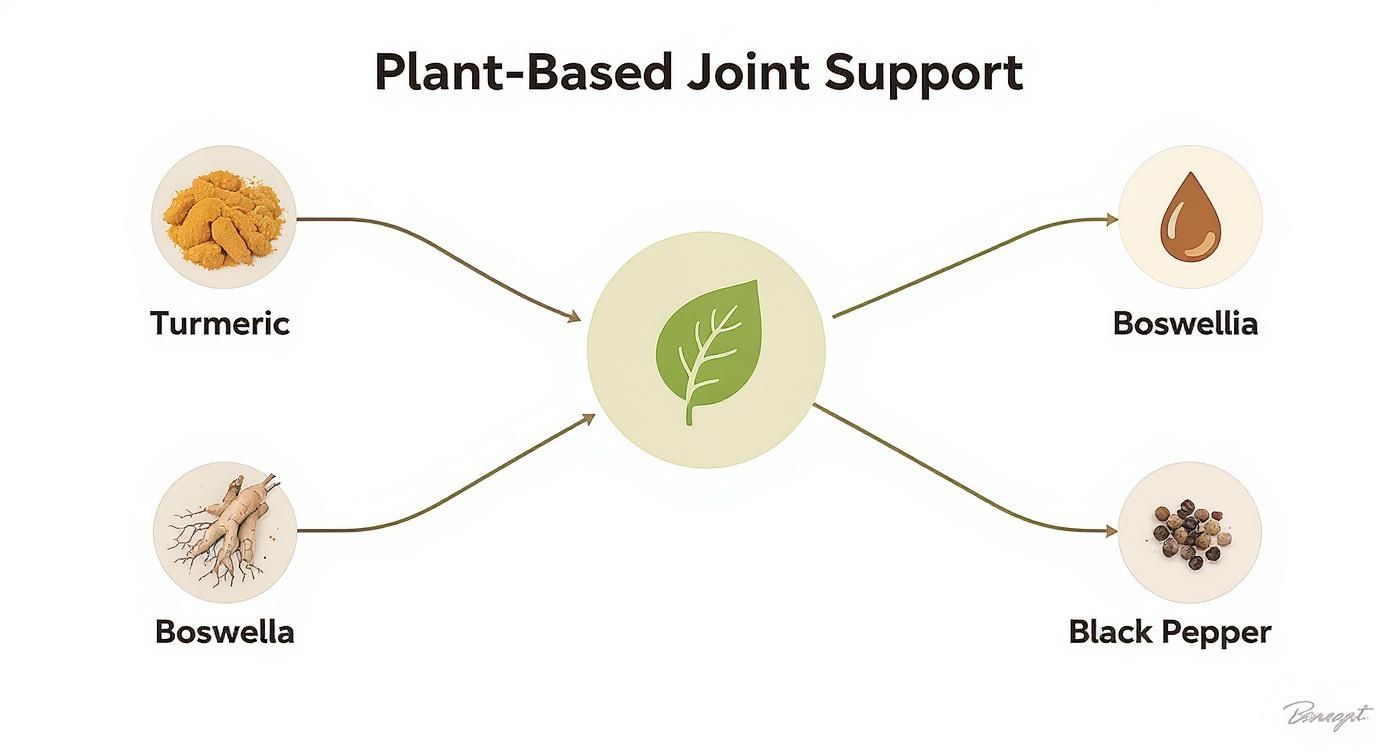
As you can see, powerhouse botanicals like Turmeric and Boswellia, paired with absorption enhancers like Black Pepper, create a powerful, interconnected system for natural joint support. It’s a holistic approach to joint health.
To make the distinction clearer, let's break down the differences head-to-head.
Comparing Animal Collagen and Plant-Based Collagen Boosters
| Feature | Animal-Based Collagen (e.g., Hydrolyzed Peptides) | Plant-Based Collagen Booster |
|---|---|---|
| Mechanism | Directly supplies the body with pre-formed collagen peptides that act as building blocks and signaling molecules. | Provides key vitamins, minerals, and amino acids (like Vitamin C & Glycine) to fuel the body's own collagen synthesis. |
| Source | Derived from animal connective tissues (bovine, marine, or chicken). | Sourced entirely from plants, herbs, and botanicals. No animal products involved. |
| Who It's For | Individuals looking for a direct supply of collagen who are comfortable with animal-derived products. | Vegans, vegetarians, or anyone who prefers to support their body's innate biological processes naturally. |
So, what's the bottom line?
For anyone following a vegan or vegetarian lifestyle—or simply for those who prefer to empower their body’s built-in systems—a plant-based booster like Staye is a fantastic option. It fuels your internal collagen factory rather than outsourcing the job.
Ultimately, whether you choose direct peptides or a plant-based booster, supporting your collagen levels is a foundational strategy for keeping your joints strong, resilient, and comfortable for the long haul.
Fueling Your Joints with Essential Micronutrients
The best joint recovery supplements work so much better when your body has a solid nutritional foundation to build on. While high-impact ingredients like collagen and curcumin get most of the spotlight, they rely on a team of unsung heroes to really get the job done. I'm talking about the essential vitamins and minerals—the micronutrients—that create the perfect environment for repair and resilience.
Think of it like building a house. The specialized supplements are your skilled laborers, but the micronutrients are the raw materials—the nails, mortar, and wiring. Without them, the whole project grinds to a halt. A truly effective plan makes sure your body has everything it needs for lasting joint health.
The Bone and Cartilage Power Duo
You can't have healthy joints without a strong framework, and that all starts with your bones. This is where the classic partnership of Vitamin D and Calcium comes in. Calcium is the main mineral that gives your bones their hardness and density, but your body can't absorb it properly without Vitamin D.
Vitamin D basically acts as the gatekeeper, unlocking the door for calcium to get from your gut into your bloodstream and finally into your skeletal system. If you're low on Vitamin D, even a high-calcium diet won't do much good, leading to weaker bones that put extra stress on the cartilage around them.
A strong skeleton is the bedrock of joint health. Getting enough Vitamin D and Calcium is a non-negotiable first step in any serious joint recovery program.
Vitamin C: The Collagen Architect
We usually think of Vitamin C for fending off a cold, but it plays an absolutely critical role in building and maintaining our connective tissues. It’s an essential cofactor in collagen synthesis, which is a fancy way of saying your body literally cannot produce new collagen without it. Taking a collagen supplement without enough Vitamin C is like hiring a construction crew but forgetting to give them any cement.
On top of that, Vitamin C is a powerful antioxidant. It helps shield your existing joint tissues from the damage caused by oxidative stress, which can speed up the breakdown of cartilage over time. To see just how vital this nutrient is for your body's natural repair process, take a look at our guide on the best Vitamin C for collagen production.
Essential Minerals for Joint Maintenance
Beyond the big names, a few other key minerals are vital for keeping your joint machinery running smoothly. They often work behind the scenes, powering crucial enzymatic reactions and contributing to the integrity of your tissues.
- Magnesium: This mineral is a workhorse, involved in over 300 biochemical reactions in the body, including those that help your muscles relax and nerves function properly. It also helps manage calcium levels, making sure it gets to your bones and doesn't end up in soft tissues where it doesn't belong.
- Zinc: Zinc is crucial for building proteins and healing wounds, which directly supports the body's ability to regenerate damaged cartilage and other connective tissues.
- Manganese: This trace mineral is essential for forming healthy cartilage and bone. It activates the enzymes needed to produce foundational compounds for your joint structure.
By making sure your diet or supplement routine includes these vital micronutrients, you’re doing more than just chasing pain relief. You're building a fundamentally stronger, more resilient system from the ground up, giving your entire joint recovery journey the support it needs to succeed.
How to Choose the Right Joint Supplement for You
Walking down the supplement aisle can feel like a pop quiz you didn’t study for. Bottle after bottle promises to be the magic bullet for joint recovery, but how do you cut through the noise and find what your body actually needs?
The secret isn't in the flashy marketing on the front of the label. It’s about learning to read the quiet, but much more important, details on the back.
Decoding Supplement Labels
First things first: ignore the hype and flip the bottle over to the Supplement Facts panel. This is your command center. It tells you everything you need to know about ingredients, dosages, and potential allergens.
Pay close attention to the dosage. You're looking for amounts that match what's been shown to work in clinical studies. For example, a good starting point for glucosamine is around 1,500 mg, while a potent turmeric extract should be closer to 500 mg.
Next, hunt for seals from third-party certification bodies. Think of these as independent watchdogs making sure what’s on the label is actually what’s in the bottle.
- NSF Certified for Sport: This is the gold standard, especially for athletes. It guarantees purity, potency, and that the product is free from over 270 substances banned in sports.
- USP (U.S. Pharmacopeia): A USP Verified mark means the supplement has the right ingredients at the right strength, doesn't have harmful contaminants, and will actually break down properly in your body.
- GMP (Good Manufacturing Practices): This seal confirms the product was made in a clean, controlled facility, though it doesn't verify the ingredient amounts themselves.
These certifications give you an essential layer of confidence, assuring you that you're investing in a product that’s safe and accurately labeled.
A supplement without third-party verification is a gamble. You’re simply trusting the manufacturer’s word, which is a big risk to take with your health.
Matching Supplements to Your Lifestyle
The best joint supplement for your friend might not be the best one for you. Your activity level, personal goals, and specific needs will point you toward the ingredients that will help you most.
Let's break it down by a few common profiles.
The Competitive Athlete or Fitness Enthusiast
You’re constantly pushing your body to its limits, and your joints feel it. Your goal is a one-two punch of repair and prevention.
- Top Picks: Hydrolyzed collagen peptides have solid evidence for dialing down activity-related joint pain. Turmeric (curcumin) is also a fantastic choice for keeping post-workout inflammation in check.
The Weekend Warrior
You go hard on Saturdays and Sundays but might be more desk-bound during the week, which can lead to stiffness. You need something that can handle occasional stress and inflammation.
- Top Picks: Glucosamine and chondroitin offer great foundational support for cartilage health. Boswellia is also excellent for protecting cartilage from the breakdown caused by those intense-but-infrequent workouts.
The Individual with Age-Related Stiffness
Your focus is on improving mobility, easing that daily discomfort, and keeping your joints functioning well for the long haul.
- Top Picks: A combination of Vitamin D and Calcium is crucial for bone density, which is the scaffold supporting your joints. A plant-based collagen booster like Staye, packed with Vitamin C and key amino acids, can give your body the tools it needs to produce its own collagen for more resilient joints.
Interestingly, it’s not just older adults thinking about joint health. Proactive care is a growing trend, with research showing about 18% of adults aged 18-34 and 19% of those 35-54 are already using joint supplements regularly. You can dig into more of these consumer trends in the joint supplement market.
No matter which profile fits you best, always chat with a healthcare professional before adding a new supplement to your routine. They can help you make a smart, safe choice based on your unique health history.
Your Questions on Joint Supplements, Answered
Jumping into the world of joint health can bring up a lot of questions. From timing your expectations to knowing what works well together, figuring out the practical side of supplements is the key to actually feeling better.
Let's clear up some of the most common things people ask.
How Long Until I Notice a Difference?
This is probably the #1 question, and the honest answer is: you have to be patient. These ingredients aren't like painkillers that mask the problem; they work with your body's natural repair cycles, and that process takes time.
Most people start to feel subtle improvements in comfort and mobility within 4 to 8 weeks of consistent, daily use. For ingredients that help rebuild tissue, like a good collagen booster, it can take up to three months to feel more significant benefits as your body gets to work laying down new, healthy tissue.
Think of it like watering a plant. You don't see it sprout overnight, but with consistent care, you're building a strong, resilient foundation day by day. Sticking with it is everything.
Can I Combine Different Joint Supplements?
Absolutely. In fact, "stacking" supplements is often a really smart strategy. Many of these ingredients work on different pathways in the body, so when you combine them, you can get a synergistic effect that's greater than the sum of its parts.
For example, you could pair a plant-based collagen booster to supply your body with structural building blocks while also taking an anti-inflammatory like turmeric to help manage day-to-day discomfort.
This multi-pronged approach tackles joint health from all angles:
- Structure: Collagen boosters support the integrity of your cartilage and tendons.
- Inflammation: Ingredients like turmeric and Boswellia help manage the body's inflammatory response.
- Lubrication: Things like hyaluronic acid (often found in comprehensive formulas) support the synovial fluid that keeps joints moving smoothly.
Are Supplements Enough on Their Own?
Supplements are powerful tools, but they can't do the job alone. Think of them as one player on a bigger team—a team that includes your diet and lifestyle.
A balanced, anti-inflammatory diet full of whole foods gives your body the foundational nutrients it needs to repair and thrive. Likewise, regular, low-impact exercise (think swimming, cycling, or even walking) strengthens the muscles supporting your joints, boosts circulation, and keeps you mobile.
The most reliable path to long-term joint comfort isn't found in a single pill. It’s in the combination of smart supplementation and a healthy, active lifestyle.
Ready to give your body the plant-based tools it needs to feel its best? Staye offers a clean, effective collagen booster designed to support your joints from the inside out. Explore Staye and start your journey to better mobility today.